How to integrate GEO tactics within your existing B2B marketing strategy

10th December 2025 •
10th December 2025 •

Getting a brand, product, or service to surface in today’s search queries requires a change in strategy. The good news is, Google has lost its monopolisation on discoverability. The bad news is, your marketing strategy needs to evolve with user search behaviour.
It’s now necessary to look beyond search engine optimisation (SEO) and think tactically about generative engine optimisation (GEO). This means making your brand more visible to large language models (LLMs) such as ChatGPT, Gemini, and Perplexity.
Don’t worry, it’s not a case of ripping up the rulebook. Most of the tactics you’re already following for SEO are applicable for GEO. It’s just important to understand the nuances, find out what your current AI visibility is like, and implement adjustments to maximise reach in this AI era.
Whether your prospect is using their favourite Gen AI platform or their favourite search engine, if their query is relevant to your business, your brand should be surfaced.
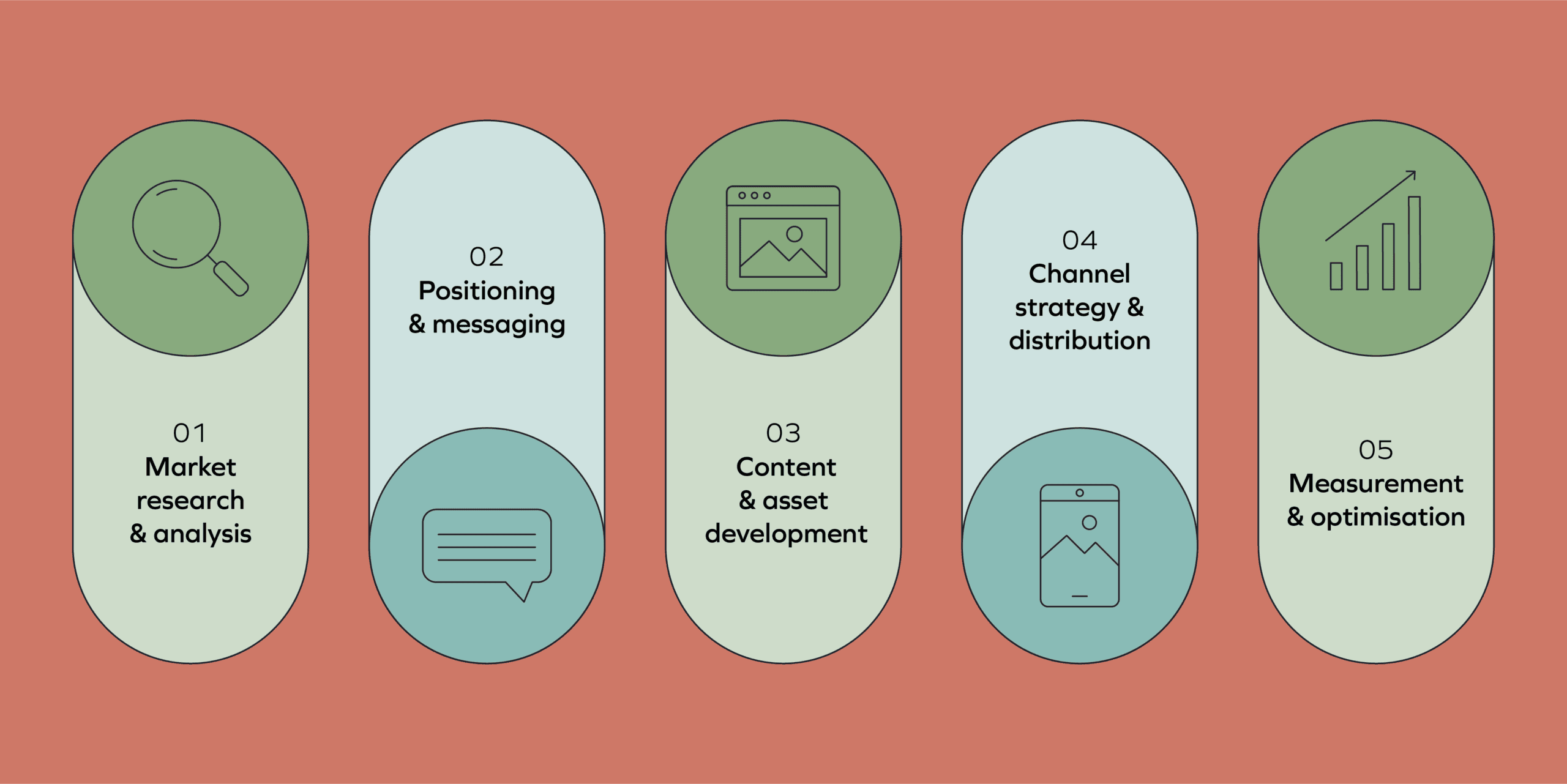
Effective market research and analysis – in the context of GEO – involves deeply integrating an understanding of generative AI usage within your initial strategy.
Developing effective positioning and messaging within the GEO framework involves crafting content explicitly designed for conversational interactions typical of LLM queries.
“ AI algorithms learn from and prioritise content that’s frequently discussed and shared across diverse and authoritative channels. ”
To excel in GEO, content creation must focus on developing educational, authoritative, and comprehensive assets that directly answer essential buyer questions.
User-generated and organic content is regularly cited in LLMs. In fact, many favour this type of content. So, it’s important you get your valuable content shared as far and wide as possible. Inviting additional commentary from partners or colleagues will give you a boost too.
From choosing your tools and metrics to working out your routine for monitoring and optimisation, it’s important to regularly review your content.
Generative AI engines pay close attention to broad signals of brand relevance and popularity. Social virality, active online discussions, media coverage, and proactive PR are all likely to boost your brand’s visibility. Why? AI algorithms learn from and prioritise content that is frequently discussed, shared, and mentioned across diverse and authoritative channels.
As such, the value of investing in creative and bold marketing has never been higher. Take LinkedIn’s paid ads as an example. They have a reputation for being expensive. We believe this is – at least in part – due to the monotony of the ads. We’re all human – boring and bland B2B ads just won’t attract attention and engagement. This can result in an eye-watering cost per lead. But it also presents an opportunity…
Imaginative and memorable campaigns will significantly amplify your brand and strengthen its market positioning. And if the bar is set low on platforms like LinkedIn, your creative ads are sure to have stand-out appeal.
In short, investing boldly at the top of the funnel is now a strategic imperative. Brands that prioritise creativity won’t just drive immediate awareness, they create powerful and lasting impacts on GEO visibility, effectively seeding their brand deeply into the AI-driven discovery ecosystem.
A large language model (LLM) is a resource loaded with vast quantities of information or ‘big data’. This model is then used by AI-powered tools like Chat GPT. These tools rely on LLMs to respond to queries.
Some of the most popular LLMs in 2026 are Chat GPT, Perplexity, Google Gemini, and Microsoft Copilot.
Highly unlikely. Copy containing marketing hyperbole is typically filtered out, with priority given to more educational resources.
Plain-language explainers, industry glossaries, and data-driven articles are much more likely to be surfaced by an LLM. So, prioritise content formats that are clearly structured, such as detailed FAQs, how-to guides, and insight-rich thought leadership articles. These align well with your users’ needs and the content preferences of generative AI.
Share of Model (SOM for short) is now a widely recognised term in the marketing world. It’s the metric that shows you what proportion of a Large Language Model’s (LLM) answer you have.
Essentially, every time someone asks the likes of ChatGPT, CoPilot, Gemini, or Perplexity a query that’s relevant to your industry and business offering, how much (or how frequently) is your brand and its content cited. Similarly, who are you sharing the space with? And what brands are dominating the SOM?
These insights should help you determine what actions to take to ensure your brand earns a larger slice of the pie in future.
For B2B marketers, it’s critical to monitor brand visibility and representation in AI – and get ahead of competitors with these rapidly-evolving discoverability tools.

This is just one chapter from our playbook: ‘Find your brand advantage: Learn how to optimise your content for generative AI engines’. For more insights from Torpedo, you can download the full story here.
Get my copy