B2B Brand Storytelling


Gareth
Gareth 6 min 23 Jul 2021

Once upon a time…

Apparently, I’ve always been something of a storyteller, from a very young age when I’d entertain anyone who would listen with dramatic tales of my adventures. At age 7, I wrote my first ‘novel’, that was read out to the whole school at assembly over the course of a week.

What do we mean by ‘storytelling’ and why is it important in marketing?

The simple truth is that stories are far more memorable and relatable than bare facts. As humans, we care infinitely more about people, places and events than we do about specs and stats. So by grounding information in a time, setting and personal context, we enable our audience to connect emotionally and rationally.

There’s no shortage of great examples of storytelling in consumer marketing. It’s in the DNA of the world’s biggest brands. But when it comes to B2B, great storytelling is harder to find.

It’s often said that ‘Reason leads to conclusions. Emotion leads to action.’ As B2B marketers, too often we stay in our comfort zone. Instead of telling engaging stories, we simply turn bulleted lists into sentences. We focus on features, functions, specifications and benefits. It’s all very rational. But does it really connect? Does it really influence behaviours and drive action?

I’m excited to report, as both a storyteller and a B2B marketing professional, that we’re beginning to see a greater understanding of the importance of storytelling among the B2B community. And I’d like to share a few key elements of storytelling that could help you take the leap and craft a compelling B2B story for your brand.

  1. Create a clear structure.

Any good story consists of three essential structural elements: beginning, middle, and end. Each of these sections needs to be clearly marked and easily recognised. Although it might be appropriate for a thriller writer to break with convention and start with a glimpse of the ending, it’s not a good idea when you’re building a B2B brand story to engage your potential customers. You need clarity, not cleverness or confusion.

Within that simple structure, you need to weave in some key components to make it compelling:

  • A strong main character
  • A challenge or crisis the character faces
  • A game-changing solution that helps the character overcome the crisis
  • A final resolution that shows the difference the solution has made in the character’s situation.

Think of any good story you’ve ever read – it almost certainly contained all of these components. If any are missing, the story will fall flat and lose your attention well before the end.

Translating this advice into a B2B brand story context, you might begin with a day in the life of your customer – Frank the factory manager. He’s facing a crisis because the company’s outdated manual processes are causing multiple delays, orders are backing up, he’s getting complaints from the sales teams as they receive angry calls from frustrated customers. But then Frank has a brain wave. He remembers the free trial of your order processing software he’d signed up for then forgotten about when things got hectic. One swift call with the IT manager later, and it’s installed across the business. It’s like flicking a switch. Everything changes – for the better. The backlog clears within minutes, sales start running smoothly as orders are despatched in record time. Now the only calls coming in are from happy customers. Crisis over. And Frank’s life is suddenly a whole lot easier.

That’s a lot more engaging for your target audience than a list of the software’s features and benefits. It also follows the well-established storytelling principle – ‘show, don’t tell.’ The story demonstrates how your product transformed your customer’s crisis; with an emotional impact your audience can relate to.

  1. Appeal to the emotions.

The reason companies are increasingly interested in brand storytelling, is that stories engage people in a way other forms of communication don’t. We’re brought up on stories. Why? Because a good story captures the imagination, contains a situation we can relate to or aspire to, and has emotional resonance. When you read or listen to a story, it’s with a sense of anticipation that you’re going to feel something – joy, delight, excitement, sadness, anger, fear, frustration, and a range of other emotions.

If the story is told well, the customer who reads/hears/watches it will be emotionally involved at every stage, and more inclined to take action at the end of it. Emotional resonance directly impacts buying behaviour. There’s so much more power in a well-told brand story than a dry sales email. You don’t need the ‘hard sell’ if you ‘show, don’t tell’ with a well-structured story that evokes an emotional response.

It’s obvious. But if you read a sample of ‘About us’ pages from company websites, how many of them feature an emotionally-charged origin story, and how many are just fact-filled potted histories that elicit no emotional response apart from a stifled yawn?

  1. Consider adding cliffhangers and plot twists.

Any decent page-turner worthy of the name will contain a few cliffhangers. The tension builds as the chapter draws to a close, and then in the final paragraph or sentence, a dramatic event or sudden jeopardy is introduced. You have no choice but to turn the page and keep on reading to discover what happens.

It never fails in fiction, but how does that fit with your brand story? While it would take a fair amount of skill to achieve the same effect within a single piece of communication, what about over a series of ads, or emails, as part of a campaign?

If a cliffhanger isn’t practical for your purposes, how about introducing a plot twist? Any story that reveals a fact, person or event that’s totally unexpected, ends up living long in the memory. You may not have even seen the film ‘The Sixth Sense’, but you’ve probably heard the line ‘I see dead people’.

In telling your brand story, think about ways you could introduce the element of surprise – maybe in the way your product or service provides your customer with the solution to overcome their challenge when all appeared to be lost. Claiming victory from the jaws of defeat never gets old.

  1. Make it shareable.

Stories began long before we had books, pens or any ability to read and write. Ancient civilisations shared tales of battles and heroic deeds around campfires, in palaces, marketplaces, and anywhere people could gather and listen. The Oral Tradition thrived because people heard exciting stories that were so memorable they were passed on from family to family, generation to generation.

Your B2B brand story will only really have an impact if it’s clear enough, strong enough, and short enough to be understood, remembered and shared by everyone in the company. It’s one thing to create a compelling brand story, and quite another thing to inspire your people to own and retell that story in their own words. If all your people live out that brand story in the way they do their jobs and how they interact with customers, then your story will have a long-lasting legacy for generations of customers.

So from one storyteller to another, I hope you find this advice helpful. Next time you’re creating content for your brand or campaign, keep these simple tips in mind and transform your content from mundane to memorable, from clinical to captivating, and from insipid to inspirational.

More for you

See the blog

Why video is the most powerful way to reconnect with your customers

Damian
Damian 3 min 11 Sep 2020

The world has changed in ways we could never have imagined. People’s routines and priorities have shifted, and the way they live their lives and purchase goods and services are significantly different now from even a few months ago.

Businesses need to think hard about how they adapt to this new landscape, and particularly how they reconnect with their customers and build meaningful, lasting relationships. We think that the strongest and most engaging way to do this is through video.

Video has unique impact.

Video offers so many levels for your business to connect with your customers. Within a video you can create trust and unite with your customers on an emotional and intellectual level. It’s a great way of deepening the relationship between your brand and your customers, and if done right, will help develop a bond that will breed loyalty, recognition and trust.

Your audience awaits.

And the great news is – your audience is out there, ready and waiting to watch your video content. Research from Cisco predicts that nearly four-fifths (79%) of the world’s mobile data traffic will be video by 2022, and that by then online videos will make up more than 82% of all consumer traffic – 15 times higher than in 2017.

Many businesses are already responding to the consumer appetite for more visual content, and are building video into their marketing strategy to build sales, brand awareness and trust with a growing customer base. According to Wyzowl’s 2020 State of Marketing report, 85% of businesses have incorporated video into their marketing strategy this year, and more than 83% of marketers attest that video content provides the best return on investment.

Where are customers most likely to watch marketing videos?

Where are customers watching these videos? Social platforms such as Instagram, YouTube and Facebook are the most common. According to Buffer, 81% of businesses now prefer to use Facebook for their video marketing. Sriniras Narayanan, Facebook’s Director of ML/AI sums up the popularity of video in consumer marketing by saying, “If a picture is worth a thousand words, a video is a library.” If you’d rather put a more specific numerical value on it, digital marketing expert James McQuivey believes that 1 minute of video is equal to 1.8 million words.

Aside from social, there’s compelling evidence that video content can be an excellent way of encouraging customers to engage with your company’s own marketing platforms. A 2017 study revealed that using video on landing pages can increase sales conversions by 80%. And simply mentioning the word ‘video’ in your email subject line can increase open rates by 19%.

You don’t even need to try and persuade your customers that video is a useful part of the buying process – they’re already convinced. A massive 90% of consumers reported that video helps them make buying decisions, while 64% say that seeing a video makes them more likely to buy a product or service.

More for you

See the blog

5 ways B2B marketeers can use Google Trends to inform strategy.

Andrew
Andrew 6 min 9 Apr 2020

Things change so quickly these days, it’s difficult for businesses to keep track. But fear not, B2B marketeers, there’s something out there that is tracking all those changes for you. And best of all it won’t cost you a penny.

Google Trends is a free tool that allows users to see trending searches and topics on Google Search. The tool is designed to organise the world’s information and make it universally accessible and useful. Although devised to feed the curiosity of the general public, Google Trends can also be used by businesses – as the provider of a wealth of data to help inform crucial marketing decisions and react to changing trends. If you work in B2B marketing, then we have picked out various scenarios to demonstrate where the tool could help you with your marketing efforts, too.

Scenario 1.

“I want to find out how an event has changed demand in my industry”

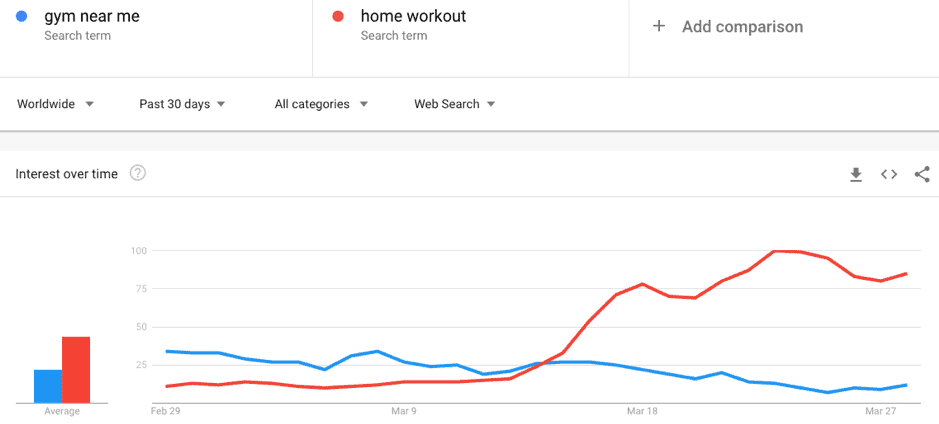
World events can cause a sudden shift in demand within your industry. As we all know, the recent Coronavirus outbreak caused sudden changes in demand that the vast majority of businesses were totally unprepared for. However, you can uncover the nuances of these demand shifts within Google trends. For example, any business related to fitness products may be keen to find ways to exploit the graph below. It shows the interest in the search term “gym near me” versus “home workout” throughout March 2020. The government-imposed lockdown throughout this period has caused a drastic change in search interest. At the start of the month “gym near me” was the more popular search term. By the end of the month, the graph paints a very different picture. “Home workout” proves a way more popular alternative for those keen on keeping in shape throughout the pandemic.

5 ways B2B marketeers can use Google Trends to inform strategy.

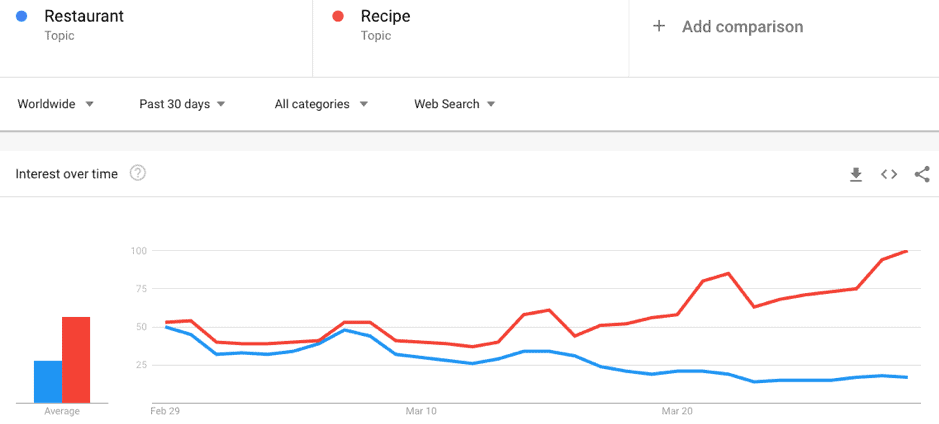
Similarly, the example below demonstrates the way consumer eating habits have changed. The graph compares the search interest in the restaurant topic compared to the recipe topic. The two were more or less neck and neck in terms of search interest at the start of March 2020, but a gulf has grown between them since the outbreak of COVID-19. Why? Well, it’s possible avid restaurant goers are trying their hand at replicating popular restaurant recipes to get a similar culinary experience at home. That’s big news if you’re a supplier of specialist ingredients.

5 ways B2B marketeers can use Google Trends to inform strategy.

Scenario 2.

“I want to find out how interest in my product compares to my competitors”

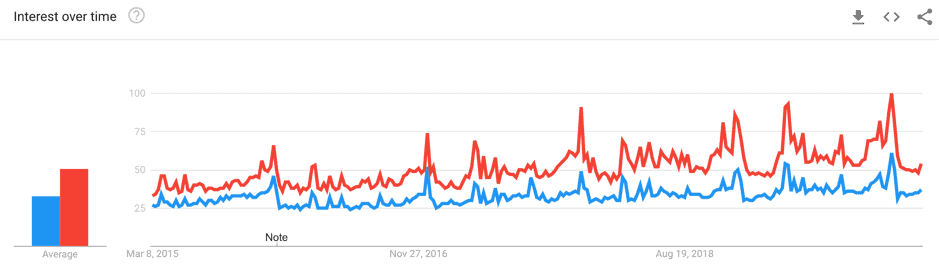
With information so readily available, it’s more important than ever to check how you stack up against your rivals. Within Google Trends you can benchmark search interest in your product, service or brand – as highlighted in the example below, comparing budget supermarkets Aldi and Lidl. The line graph represents the interest in each search term over time, on a scale from 0 to 100. The higher the number, the more popular the search at a given time. This follows a very similar trend for each supermarket which also highlights the seasonality of search interest, peaking around Christmas each year.

5 ways B2B marketeers can use Google Trends to inform strategy.

Scenario 3.

“For market expansion, I want to find which regions are most interested in my product”

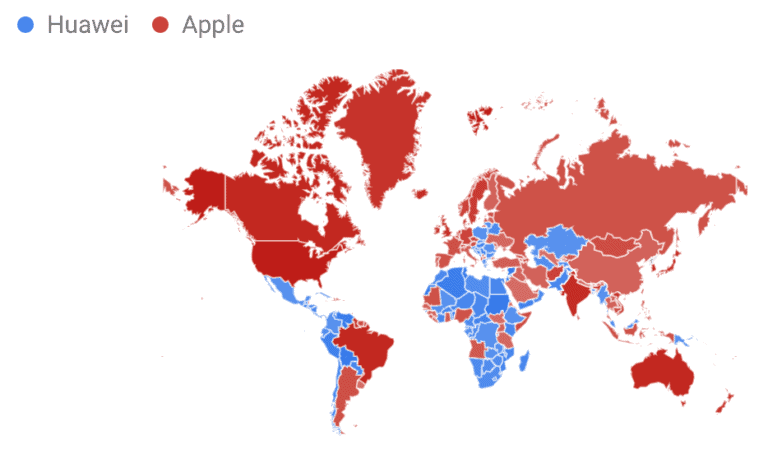
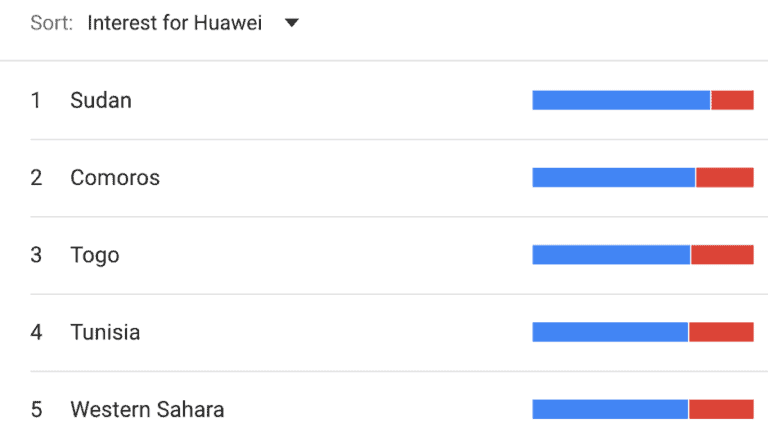
Selling your products and services globally has never been easier than it is today. This makes the idea of market expansion very attractive. With Google Trends, you can filter search interest down to regions and cities, allowing you to identify potential regional expansion prospects. The map in the image below shows the regional split in search interest between Apple and Huawei, and represents the countries each brand is most widely searched in. The regions areas in which Huawei commands a larger market share over Apple are clearly visible. Interestingly, Huawei seems to dominate much of central America and Africa, while Apple remains prominent in the rest of the world.

5 ways B2B marketeers can use Google Trends to inform strategy.

Scenario 4.

“I want to identify regions that are dominated by my competitors – to disrupt their monopoly”

Brands that command a monopolistic market share can be vulnerable to disruptive innovation – from grass roots firms or larger players backed by heavy investment. Google Trends allows you to identify the regions that are dominated by potential competitors that could, potentially, be vulnerable to disruptive innovation. That includes areas where your business already has a presence, but might be looking to command a larger market share through an aggressive marketing strategy.

5 ways B2B marketeers can use Google Trends to inform strategy.

Scenario 5.

“I want to find trending queries and topics around my product, to inform my content strategy”

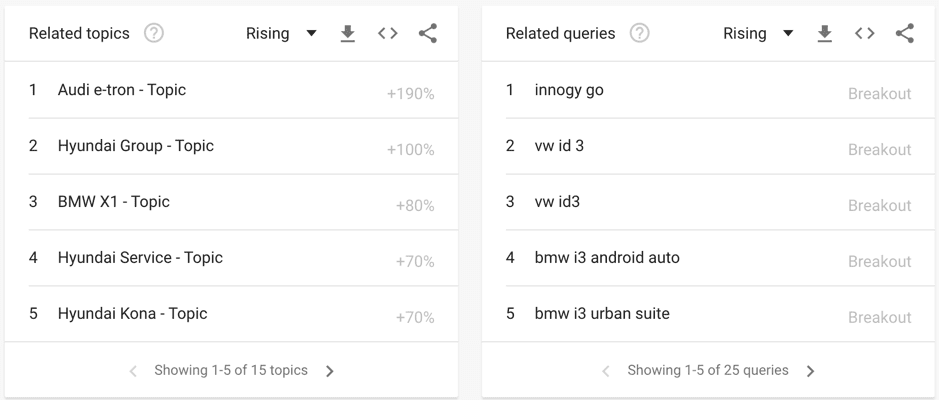
Finding topics related to your brand can help you to uncover the comparisons that searchers are making between your product and alternatives in the marketplace. Google Trends allows you to see which related topics are growing in popularity, giving you the chance to jump on the bandwagon, react to changing interests, then shift the attention from alternative brands to yours. The image below provides an example of the rising topics and queries related to the ‘BMW i3’. Notably, related topics include other key players in the electric car industry, namely Audi and Hyundai.

5 ways B2B marketeers can use Google Trends to inform strategy.

These can be sorted by the queries that are ‘Rising’ in popularity – indicating the biggest increase in search frequency – or by the ‘Top’ (most popular) search queries, overall. ‘Rising’ can also turn to ‘Breakout’. This is when a topic or keyword is receiving a massive increase and the search term has grown by over 5000% (!)

“How do I find this free information?”

Raring to go? To access the tools in the scenarios above, click on the hamburger button [menu icon] in the top left of the Google Trends homepage, then select ‘Explore’. On the Explore page, type in your search query, then click on ‘+ Compare’ to choose a search term to compare it with.

“Can I receive updates regarding trends relating to my brand or industry?”

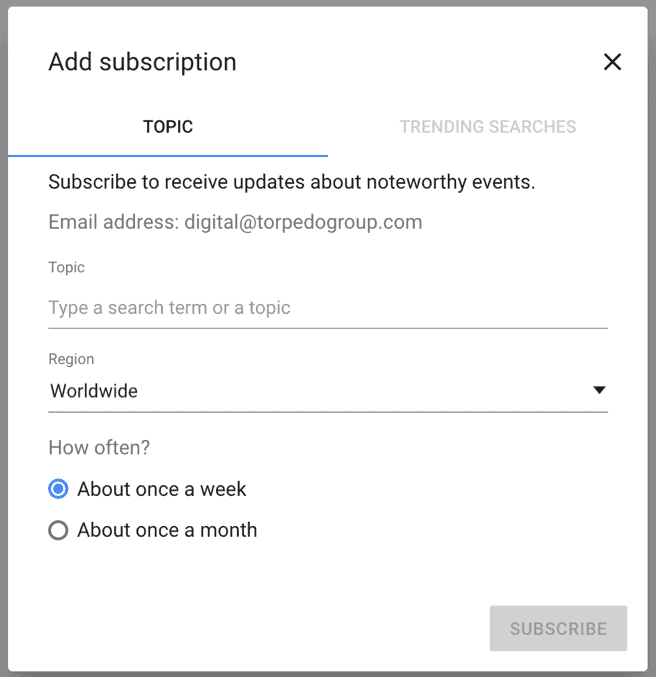
Yes. Previously, staying up to date with industry developments – and how people are relating to brand-related trends – was a tall order. Google Trends, however, allows you to subscribe to updates, so that you can receive a weekly digest on the trends that are exclusive to you. This is a perfect solution for time-poor marketers who just want the top, tailored headlines delivered on a weekly or monthly basis.

5 ways B2B marketeers can use Google Trends to inform strategy.

To subscribe to updates, again, click on the hamburger button in the top left of the Google Trends homepage, then select ‘Subscriptions’. On the subscriptions page click the ‘+’ in the bottom right hand corner, then follow the on-screen instructions to set up your subscription.

You’ll find Google Trends a great starting point for assessing search trends related to your business, but if you’d like to take things a step further and go into more detail, then talk to Torpedo. Equally, If you’d like to know more about Google Trends data then check out the Google Trends FAQs page.

Of course, even in the short time that’s elapsed since we released this blog into the world, that world will have changed yet again. What remains the same is Google Trends ability to track those changes so you can stay one step ahead of your competition.

And the fact that it’s free? Well, let’s hope that never changes.

More for you

See the blog

10 things you need to know before you get started with ABM.

Andrew
Andrew 8 min 27 Aug 2019

If you’re a B2B marketer you’ve probably heard a lot of talk about Account Based Marketing (ABM) recently. It’s true that there’s a lot of noise out there right now about ABM, and in particular a lot of Martech vendors are putting their own spin on it. This makes for a complicated and slightly fuzzy picture of what ABM actually is.

So, to help clear things up, here’s my unbiased introduction to ABM that answers some of the most common questions, and gives some practical advice about getting started.

1. What is Account Based Marketing (ABM)?

As marketers, we all know that the fundamentals of successful communication are all about right message, right audience, right time. The more focused the audience and the better the audience insight – the more successful your campaign will be. Essentially, ABM is about taking these fundamental principles to the next level to create strategies, propositions, content and creative communications for specific individuals in high-priority accounts.

In a nutshell, ABM is about marketing to segments of one. Or to use the definition of ABM provided by Information Technology Services Marketing Association (ITSMA): Account-based marketing, put simply, is “treating individual accounts as markets in their own right.”

It’s important to recognise that ABM is much more than a marketing tactic. ABM is a long- term strategic business initiative. It requires buy-in from senior stakeholders in your business and a need for sales and marketing teams to work more closely than ever before to provide customers and prospects with a completely joined-up experience through every stage of the buying journey.

2. Is ABM just super-targeted demand generation?

Although the foundational principles of ABM and demand generation are the same, the methodologies are very different. With a traditional demand generation approach, the role of marketing tends to be focused at the top of the funnel, with success measured on engagement metrics and the volume of leads generated – then it’s over to the sales team to close the deal. With ABM there is no top of the funnel – you choose the businesses you want to go after.

So, rather than casting a wide net and hoping that some good opportunities swim into it, you identify the big opportunities and focus on catching them. To take the analogy further, if traditional demand generation is like fishing with a net, then ABM is fishing with a spear.

3. What are the benefits of ABM?

ABM really works. There’s plenty of evidence of tangible, measurable benefits being reported by lots of businesses that have adopted ABM. According to ITSMA, 70% of organisations that implemented ABM substantially improved their account revenue, and 89% of businesses report an increase in deal size with ABM, as noted in Sirius Decisions’ State of ABM report.

For me there are also some really significant cultural benefits. ABM brings better alignment between sales and marketing teams within businesses. In my experience, these two functions often have a difficult relationship with one another. By adopting an ABM approach, marketing and sales teams need to work more closely. From identifying the target accounts, through to developing strategies, and even the deployment and reporting of success. In an ABM world, sales and marketing teams share the same targets and share in each other’s successes.

More than anything else, I love the fact that ABM is prompting businesses to rediscover the value of audience insight.

4. How do I scale my ABM programme?

This is the question I get asked more than any other, but it’s also a bit of an oxymoron. When we talk about ABM at scale, we’re really talking about programmatic ABM (or one-to-many ABM). It’s a relatively new concept that’s been enabled by new technology platforms in the last few years. This approach allows businesses to use some very clever technology to extend their ABM propositions and content to a much wider pool of accounts.

As an ABM purist I would argue that Programmatic ABM isn’t really ABM at all, but regardless of what you call it, it’s undeniably a powerful way to extend the value of your investment in ABM and lower the risk of ABM adoption.

If you want to implement ‘ABM at scale’ you will need to invest in an ABM platform. Some of them are really impressive, but they can also have a hefty price tag to match.

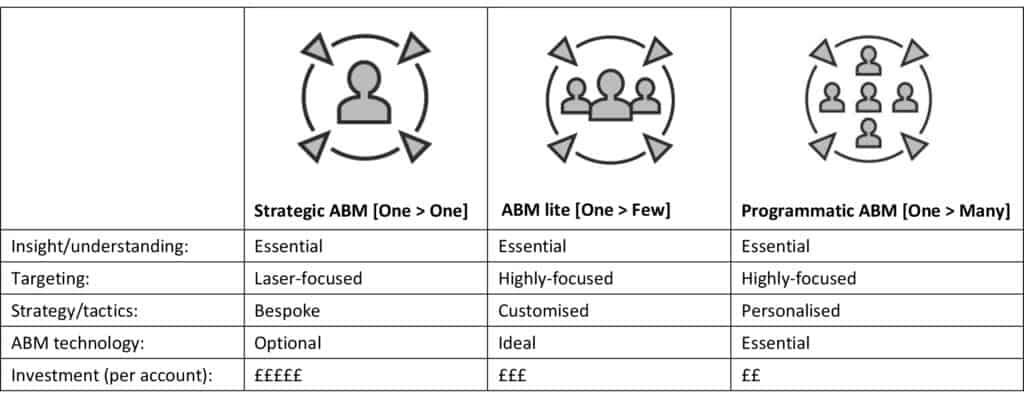
5. What are the different types of ABM?

ITSMA defined three different types of ABM in the 2010 practitioners Guide to ABM, and today this terminology has become prevalent among marketers and ABM experts.

The three types of ABM are:

i. Strategic ABM, or one-to-one ABM: This approach focuses on target accounts on a completely individual level. When adopting a Strategic ABM approach, you’ll look to understand everything about the business and the individual stakeholders within the decision-making unit. You’ll design strategies, propositions, and content that speak to their individual challenges. The approach will be completely bespoke, designed specifically for that account.

ii. ABM lite, or one-to-few ABM: This approach focuses on a handful of target accounts which have a level of commonality – typically around shared challenges. With an ABM lite approach, you’ll be creating strategies, propositions and content that can be tailored to each of the accounts. An ABM lite programme would typically focus on between 5 and 20 accounts.

iii. Programmatic ABM, or one-to-many ABM: Essentially this a hybrid between ABM and demand generation and can be used to supplement one of the other two approaches. Programmatic ABM uses technology to intelligently deploy your messaging and content to accounts that demonstrate similar behaviour to your priority target accounts

6. How do I choose the right accounts to target?

The criteria that make a best-fit account for you will be different from what makes a best-fit account for another business. Your account selection criteria are likely to take several factors into account. These might include the potential value of the business, their current position in the sales cycle for a product/service like yours, existing contacts and relationships within the account, or even the prestige that landing a certain account would bring.

One thing that is certain is that you should work closely with your sales team to select the target accounts for your ABM programme. They will understand better than anyone where the big opportunities are. And by working with sales to set the direction of travel they’ll be engaged from the outset.

7. Why is alignment between sales and marketing so important with ABM?

Unlike the traditional demand generation where the marketing team is responsible for delivering MQLs (Marketing Qualified Leads) and then passing the baton to sales teams to pick up the relationship and close the deal, successful ABM aims to deliver seamless, tailored customer experiences throughout the customer journey. Sales and marketing work together to understand customer challenges at every stage and collaborate to create and deliver customised content – relevant to the specific target.

8. Should I use ABM for new prospects or existing customers?

Both. ABM has proven to be really successful for in both scenarios: landing net-new business and expanding into existing accounts. In both scenarios, ABM is widely acknowledged to increase average deal size. According to the Sirius Decisions, State of ABM Report, 89% of businesses report an increase in deal size with ABM.

9. Isn’t ABM expensive?

Yes and no. ABM is all about quality rather than quantity. So, while there is a bigger investment in planning, strategy and content creation per account, you’ll only be focusing on a handful of carefully selected opportunities.

Don’t forget – ABM is a long-term ongoing commitment which will require funding to match.

There are some ABM budget calculators available online. By all means give them a try – they will help you to understand a base level investment required but remember the very nature of ABM means that the approach you adopt for one account could be very different to the one you adopt for another. Therefore, you should take these calculations with a pinch of salt.

10. What software and platforms do I need for Account-Based Marketing?

While the current narrative around ABM features a lot of talk about technology platforms, implementation of lots of new tech isn’t a requirement. We have worked with clients to execute both high-tech and low-tech ABM programmes.

Intent data platforms can be used to provide amazing insights in the early phases of an ABM programme; social media (LinkedIn, Facebook, Twitter, etc.) can be hooked up to deliver tailored ABM messages and content; ABM platforms can be employed to amplify your programme and your CRM can be hooked up to monitor attribution.

We can support you with all of this – however, for me the methodology is more important than the technology. Focus on getting the strategy right first, and then use technology to take your ABM programme to the next level when you’re ready.

In my opinion, if you focus on the technology first and foremost, you’re likely to miss the real value and opportunities that ABM offers.

If you’re keen to get started with Account Based Marketing, an ABM pilot programme is a good way to go. We’ve helped several of our clients start their own ABM journey in this way. We believe that the key to successful ABM is about getting to grips with the methodology first and then introducing the technology if and when you’re ready. We recommend building a pilot programme that uses the tools you already have in play and leverages the knowledge and expertise in your business. By following a straightforward process, you can start your own ABM journey in this way.

More for you

See the blog