A creative perspective on B2B marketing trends in 2026


Joe
Joe 1 min 29 Jan 2026

With AI adoption accelerating around the world, it will come as no surprise that it’s influenced many of our Creative Team’s predicted B2B marketing trends for 2026. But rather than framing AI as disruptive or daunting, we see it as an exciting catalyst – one that deepens insight, elevates creativity, and expands what’s possible for us to create.

AI will be ever-more present – and firmly integrated – into our workflows in 2026. And that’s something we as a brand marketing agency welcome. The way that we’re choosing to integrate AI amplifies our ability to deliver extraordinary solutions for our clients.

Some headlines you may have read would suggest that AI prompts will replace creative thinking. We take the opposite view. Human creativity is the irreplaceable spark that makes AI outputs strategic, meaningful, and effective. And we shouldn’t lose sight of the fact that those outputs are still just one part of a wider, multifaceted B2B marketing ecosystem.

The digital landscape is increasingly becoming saturated by AI-generated content. It’s reshaping how organisations use video, design, and content to build trust and stand out. But just because it’s easier to scale production and publish more, it doesn’t mean you should.

The more strategic choice is to use AI to dig deeper – to truly understand your market, your prospects, and what they need from you. That’s how it can help us humans develop compelling creative that successfully captures the attention of your prospects. After all, right now countless communications are competing for it.

There are plenty of tempting use cases for AI, but it’s critical that you make sure you pick and choose them carefully. Churning out AI-generated content at scale won’t build your brand. In fact, it could even damage your reputation in the long run.

As we accelerate on our own AI adoption journey, our carefully considered AI-enabled creative workflows will empower our team – to amplify ideas, elevate executions, and extend the effectiveness of all our creative output.

Here’s how we see AI shaping B2B marketing trends in 2026:

1. Human-crafted creative with AI enhancements will shine.

AI has led people to savour unique perspectives and human connection more than ever before. Your audience is becoming more sensitive to what feels human. Authenticity and characterful creative is what will help you build valuable emotional connections and brand affinity with your audience.

AI won’t replace this, but it can enhance it. By blending human-crafted creative with AI-driven personalisation, brands can create deeply relevant, tailored experiences at scale. A single in‑depth master playbook can become a rich source of modular, personalised content – adapted for markets, industries, roles, and user needs with ease. Or a 1,000-word case study can quickly transform into an executive summary, an infographic, or even a podcast. AI helps creative work work harder.

2. Purposeful creative assets will drive stronger results.

Sometimes less is more. 2025 research from Netline shows that the content consumption gap is only getting bigger. Yes, the B2B buyer journey is often complex and requires many touchpoints to guide from awareness to consideration to conversion, but we need to be strategic and selective about what those touchpoints are. We need to make sure every single asset feels relevant to the user. Despite AI having the ability to scale content to infinity (and beyond), let’s remember our B2B audience’s attention is finite. Making sure every piece of content has a clear purpose will help to build your brand’s authority and show you respect your prospect’s time.

3. Scaling your brand ambassadors will become easier.

No more waiting for the perfect diary slot. By filming an executive just once, AI can now help us to scale their presence by more easily developing consistent, accessible content across multiple formats. All the while relying on expert human judgement to maintain authenticity, quality, and integrity.

Better still, AI-driven localisation with human oversight presents us with an opportunity to reach global audiences and ensure your brand’s thought leadership has the widest possible reach – and impact.

4. Brand creative will be braver and bolder.

Creative has always been a point of differentiation, but now more than ever, it’s key to achieving stand-out. With content saturation across every market, it’s critical to determine what makes your brand different and ensure all your assets deliver on this. AI can help brands uncover competitive insights faster and, with a clearer understanding of the market landscape, more confidently express who they are, what makes them unique, and how they can show up across every touchpoint in the most creatively-compelling way.

5. Stronger brands will be powered by flexible frameworks and design systems.

AI is only as effective as the data and guidance behind it. For branding, this translates into robust frameworks – built by specialists. It’s these frameworks that give AI the foundation to scale and amplify a brand, consistently. Comprehensive guidelines covering brand story, values, visuals, tone of voice, messaging, and more ensure that AI can become a powerful brand partner – rather than a risk to your hard-earned brand equity.


More for you

Discover more of the latest thinking from Torpedo.


How to integrate GEO tactics within your existing B2B marketing strategy

Becky
Becky 1 min 10 Dec 2025

Getting a brand, product, or service to surface in today’s search queries requires a change in strategy. The good news is, Google has lost its monopolisation on discoverability. The bad news is, your marketing strategy needs to evolve with user search behaviour.

It’s now necessary to look beyond search engine optimisation (SEO) and think tactically about generative engine optimisation (GEO). This means making your brand more visible to large language models (LLMs) such as ChatGPT, Gemini, and Perplexity.

Don’t worry, it’s not a case of ripping up the rulebook. Most of the tactics you’re already following for SEO are applicable for GEO. It’s just important to understand the nuances, find out what your current AI visibility is like, and implement adjustments to maximise reach in this AI era.

Whether your prospect is using their favourite Gen AI platform or their favourite search engine, if their query is relevant to your business, your brand should be surfaced.

Our step-by-step guide to implementing a GEO strategy.

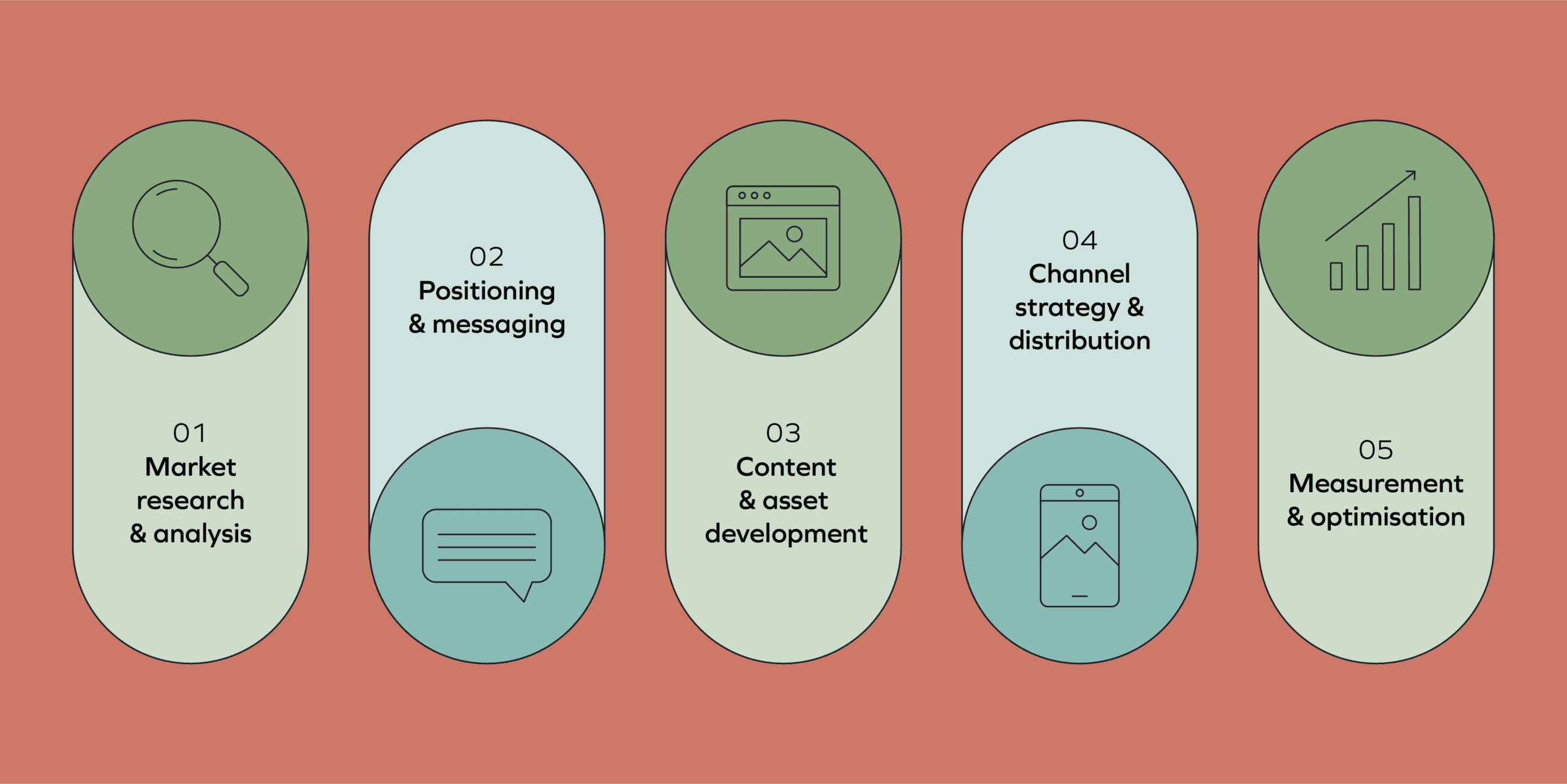
Stage 1: Market research and analysis.

Effective market research and analysis – in the context of GEO – involves deeply integrating an understanding of generative AI usage within your initial strategy.

  1. Determine your ‘core query set’: identify the specific industry-related questions that your target audience frequently asks. This doesn’t need to be queries that have come from LLMs, but ones that prospects are likely to ask LLMs in the future. Actually, the best way to curate this list is by using your CRM data or speaking with your sales team. It’s important you note the language prospects use. So, analyse sales calls scripts and build your understanding of what they want to know – and when. This should give you crucial insights into buyer intent and conversational patterns. In turn, it’ll allow you to structure your content and messaging in a way that mirrors your prospects AI queries.
  2. Competitor analysis: conduct a comprehensive competitor visibility analysis to gauge how well others are already performing within these generative AI environments. Identify competitors who regularly appear within LLM-generated responses and explore why their content or brand resonates with AI algorithms. This competitor analysis will help you pinpoint what GEO strategies and tactics are already working, providing a robust foundation for your GEO efforts.

Stage 2: Positioning and messaging.

Developing effective positioning and messaging within the GEO framework involves crafting content explicitly designed for conversational interactions typical of LLM queries.

  1. LLM-ready messaging: Your positioning statements and key messages should naturally fit question-and-answer formats, aligning seamlessly with user expectation.
  2. Keyword and phrase alignment: incorporate exact-match conversational phrases that your audience frequently uses, ensuring your messaging closely aligns with real-world user interactions. This careful linguistic synergy boosts your visibility in AI-generated responses.

“ AI algorithms learn from and prioritise content that’s frequently discussed and shared across diverse and authoritative channels. ”

Stage 3: Content and asset development.

To excel in GEO, content creation must focus on developing educational, authoritative, and comprehensive assets that directly answer essential buyer questions.

  1. GEO-aligned content creation: Prioritise content formats that are clearly structured, such as detailed FAQs, how-to guides, and insight-rich thought leadership articles. These formats – not coincidently – align well with your users’ needs and the content preferences of generative AI. These content types will enhance your chances of being surfaced and cited in LLM responses.
  2. Strategic use of data: Embed unique, original statistics and insights into your content to encourage citation and enhance brand SOM.

Stage 4: Channel strategy and distribution.

User-generated and organic content is regularly cited in LLMs. In fact, many favour this type of content. So, it’s important you get your valuable content shared as far and wide as possible. Inviting additional commentary from partners or colleagues will give you a boost too.

  1. Content syndication and PR: Ensure your core thought leadership and educational assets are shared across influential industry platforms, authoritative third-party websites, and high-visibility media channels.
  2. Forum and community engagement: If relevant, actively engage in professional communities such as LinkedIn, Stack Overflow, Quora, and Reddit. Getting involved in these communities helps seed your content in areas commonly referenced by generative AI models.

Stage 5: Measurement and optimisation.

From choosing your tools and metrics to working out your routine for monitoring and optimisation, it’s important to regularly review your content.

  1. GEO monitoring tools: Utilise specialised monitoring tools to continuously measure your brand’s ‘Share of Model’ (SOM) and sentiment across various LLM platforms.
  2. Iterative improvement: Regular analysis of these metrics allows you to identify visibility gaps and areas for improvement. Use these insights to iterate and refine your content and distribution approaches. This ongoing optimisation ensures your GEO strategy remains effective, adaptive, and consistently aligned with evolving generative AI algorithms and user behaviours.

Do all the above, but above all, be bold.

Generative AI engines pay close attention to broad signals of brand relevance and popularity. Social virality, active online discussions, media coverage, and proactive PR are all likely to boost your brand’s visibility. Why? AI algorithms learn from and prioritise content that is frequently discussed, shared, and mentioned across diverse and authoritative channels.

As such, the value of investing in creative and bold marketing has never been higher. Take LinkedIn’s paid ads as an example. They have a reputation for being expensive. We believe this is – at least in part – due to the monotony of the ads. We’re all human – boring and bland B2B ads just won’t attract attention and engagement. This can result in an eye-watering cost per lead. But it also presents an opportunity…

Imaginative and memorable campaigns will significantly amplify your brand and strengthen its market positioning. And if the bar is set low on platforms like LinkedIn, your creative ads are sure to have stand-out appeal.

In short, investing boldly at the top of the funnel is now a strategic imperative. Brands that prioritise creativity won’t just drive immediate awareness, they create powerful and lasting impacts on GEO visibility, effectively seeding their brand deeply into the AI-driven discovery ecosystem.

FAQs

A large language model (LLM) is a resource loaded with vast quantities of information or ‘big data’. This model is then used by AI-powered tools like Chat GPT. These tools rely on LLMs to respond to queries.

Some of the most popular LLMs in 2026 are Chat GPT, Perplexity, Google Gemini, and Microsoft Copilot.

Highly unlikely. Copy containing marketing hyperbole is typically filtered out, with priority given to more educational resources.

Plain-language explainers, industry glossaries, and data-driven articles are much more likely to be surfaced by an LLM. So, prioritise content formats that are clearly structured, such as detailed FAQs, how-to guides, and insight-rich thought leadership articles. These align well with your users’ needs and the content preferences of generative AI.

Share of Model (SOM for short) is now a widely recognised term in the marketing world. It’s the metric that shows you what proportion of a Large Language Model’s (LLM) answer you have.

Essentially, every time someone asks the likes of ChatGPT, CoPilot, Gemini, or Perplexity a query that’s relevant to your industry and business offering, how much (or how frequently) is your brand and its content cited. Similarly, who are you sharing the space with? And what brands are dominating the SOM?

These insights should help you determine what actions to take to ensure your brand earns a larger slice of the pie in future.

For B2B marketers, it’s critical to monitor brand visibility and representation in AI – and get ahead of competitors with these rapidly-evolving discoverability tools.


Insights

More for you


Building a GEO strategy based on the leading LLM – ChatGPT

Andrew
Andrew 1 min 19 Aug 2025

The ways in which people discover your brand are changing. Traditional search engine optimisation (SEO) strategies are simply no longer enough on their own.

The search for, say, a SaaS product for a small tech company use to begin with, “best CRM SaaS solution”. Today, thanks to Large Language Model (LLM) tools like Gemini, Claude, or ChatGPT, it can be, “recommend a CRM SaaS solution for a small technology enterprise that leverages AI to optimise workflows and has powerful features that enable remote collaboration“ – and chances are, you’ll get all that information (and more) back in one concise paragraph – or better still, within a comparison table!

That means planning a GEO (generative engine optimisation) strategy to ensure your brand, product or service is the one that surfaces among the search results. And if there’s one LLM you should prioritise your GEO strategy around, it’s ChatGPT.

The growth trajectory of the leading LLM has been nothing short of extraordinary, solidifying its position as the most widely adopted tool of its type to date. As of May 2025, ChatGPT boasts approximately 800 million weekly active users and around 122.58 million daily users, processing over 1 billion queries daily. This rapid rate of adoption underscores its deep integration into users’ daily routines and its prominence in the AI landscape.

In comparison, other LLMs are far behind in terms of their share of AI search. For instance, Google’s Gemini has garnered about 450 million monthly users as of July 2025. Notably less than ChatGPT’s user base. Then there’s an even greater drop off for popular tools like Claude and Perplexity (approximately 18.9 million and 22 million monthly active users respectively). This disparity highlights ChatGPT’s dominant position.

While the results for LLMs are impressive, however, it’s not time to abandon your SEO strategy just yet.

What’s comforting to know is that since Gemini’s (and the AI Overviews’) own algorithms are likely to be more closely aligned to Google’s search algorithm, if you prioritise ChatGPT for your GEO strategy, and Google for your SEO, you should have a really strong reach.

So, let’s look at the main considerations for a ChatGPT-based GEO strategy…

“ When ChatGPT generates answers using its browsing tool, it retrieves content through Bing Search – not Google. ”


1. ChatGPT uses Bing to generate answers.

This is a fundamental – and perhaps surprising – point. When ChatGPT generates answers using its browsing tool, it retrieves content through Bing Search – not Google. The model looks at Bing’s website and content ranking, summarises the information, and cites or references brands based on what it finds.

Why is this so important? Because if you don’t rank on Bing, you’re invisible to ChatGPT’s real-time answers. In essence, just as SEO was once all about Google, GEO for ChatGPT is now largely about Bing. B2B marketers who optimise for both engines can increase their brand’s visibility across the most important discovery pathways available today – and tomorrow.

“ If you don’t rank on Bing, you’re invisible to ChatGPT’s real-time answers. Just as SEO was all about Google, GEO for ChatGPT is largely about Bing. ”


2. If people talk about your brand, AI is more likely to give you a shout out.

ChatGPT and other LLMs are trained on vast text corpus, scraped from the public web. During training, these models ‘learn’ word associations and frequencies. If your brand is consistently mentioned near key industry terms, your name becomes statistically entangled with those topics. For example, if the phrase “best enterprise CRM” frequently appears with the word “Salesforce” in the training data, the model learns to associate them. This matters because LLMs don’t rank links – they predict language. If your brand has been part of the public dialogue around a subject, the model is more likely to include you in its generated answer.

“ LLMs don’t rank links – they predict language. If your brand is part of the public dialogue around a subject, the model is more likely to include you in its generated answer. ”


3. Retrieval-augmented generation (RAG) models look beyond the top link.

Most leading LLMs – including ChatGPT, Gemini, and Perplexity – integrate live search to fetch current content. They rely on retrieval to complement their training. In these cases, LLMs extract answers from top-ranked, recent, and contextually relevant web content. Studies show that when they cite content, the majority of these sources come from the top 20 search results. This means your organic ranking still matters and, crucially, you don’t need to be one of the first few links to be scanned and cited by LLMs. Overall, pages that rank well are more likely to be seen and selected by AI.

“ Studies show that most sources come from the top 20 search results. Organic ranking still matters and, crucially, you needn’t be one of the first few links to be scanned and cited by LLMs. ”


4. ChatGPT surfaces content that demonstrates expertise.

Beyond simply grabbing the top-ranked search results, LLMs like ChatGPT evaluate each potential source through a wider lens of relevance and authority. They favour content that is comprehensive and organised with clear headings or FAQ-style sections. This makes it easy for them to extract key information. If this content is published on domains already recognised for expertise and trustworthiness, its chances of being chosen increase further. Essentially, pages that meet these criteria – depth, clear structure, and proven authority – stand a far better chance of being surfaced in ChatGPT’s answers.

“ Pages with depth, clear structure, and proven authority stand a far better chance of being surfaced in ChatGPT’s answers. ”


5. Choose helpfulness over hype – use utility-first, non-promotional content.

Promotional fluff is largely ignored. LLMs give priority to material that puts utility ahead of salesmanship. Copy laden with marketing hyperbole is typically filtered out, whereas educational resources that answer a user’s question are prioritised. Well-researched thought-leadership pieces, plain-language explainers, industry glossaries, and data-driven articles provide the kind of concrete, non-promotional value an LLM is designed to surface. As a result, content created with a ‘help-first’ mindset is far more likely to be summarised or cited in an AI-generated response.

“ Well-researched thought-leadership pieces, plain-language explainers, and data-driven articles provide the non-promotional value an LLM is designed to surface. ”


6. Originality and data points are the key to earning mentions.

LLMs actively seek out content that offers something new. This could be proprietary frameworks, fresh analysis, or hard-to-find data points. When you publish original statistics, you give the model a concrete fact it can cite verbatim and attribute back to your brand. Imagine your white paper reports that: 34% of manufacturers plan to reshore production by 2026; if that figure is novel and starts circulating, LLMs are likely to repeat it and credit you whenever the topic arises. In short, the more distinctive your insights, the greater your chances of becoming the authoritative source an AI surfaces and cites.

“ When you publish original statistics, you give the model a concrete fact it can cite verbatim and attribute back to your brand. ”


And finally, keep it fresh…

What the above tells us is that ChatGPT and other AI models are constantly seeking credible sources with original data to cite. But as AI-generated content becomes more prevalent, a new challenge emerges: will originality become harder to find?

Essentially, as AI-generated content floods the web, brands risk being lost in a sea of sameness. If you don’t at least give the model some net-new information to work with, the waters will soon be muddied with everyone citing the same few original sources.

The point is: if you’re using AI to create content, do so cautiously. Human-generated content will be key for GEO. If you need to use AI as a tool to optimise content written by humans, great. But if you’re using it to churn out content without human input and insights, it’s unlikely to be valuable to humans, and it’s unlikely to help you on your GEO mission either.

FAQs

A large language model (LLM) is a resource loaded with vast quantities of information or ‘big data’. This model is then used by AI-powered tools like Chat GPT. These tools rely on LLMs to respond to queries. Some of the most popular LLMs in 2025 are Chat GPT, Perplexity, Google Gemini, and Microsoft Copilot.

When ChatGPT generates answers using its browsing tool, it retrieves content through Bing Search. The model looks at Bing’s website and content ranking, summarises the information, and cites or references brands based on what it finds. This is important, because if you don’t rank on Bing, you’re invisible to ChatGPT’s real-time answers.

RAG is an acronym for Retrieval-Augmented Generation. Essentially, it enhances the capabilities of LLMs like ChatGPT by integrating them with external sources of information and content. By allowing LLMs to access and incorporate info from web pages, databases, documents and other sources, the models provide more accurate, up-to-date and contextually relevant answers to searches.

Highly unlikely. Copy containing marketing hyperbole is typically filtered out, with priority given to more educational resources. Plain-language explainers, industry glossaries, and data-driven articles are much more likely to be surfaced by an LLM like ChatGPT.

Figures released in May 2025 showed ChatGPT had around 800 million active users every week. By comparison, the next most popular LLM, Google’s Gemini, had only half that number – and that was per month (April 2025 figures). Likewise, competitors Claude and Perplexity showed approximately 19 million and 15 million, respectively.


Insights

More for you


How to do B2B storytelling: A GTM agency’s guide to content that converts

Andrew
Andrew 1 min 3 Jul 2025

In a world where B2B buyers are bombarded with content, storytelling isn’t just a nice-to-have – it’s a strategic differentiator. At our B2B go-to-market (GTM) agency Torpedo, we’ve seen how the right narrative can transform a brand from forgettable to unforgettable. But what does effective B2B storytelling actually look like? And how do you make it work for your business?

Let’s break it down.

Why storytelling matters in B2B

Storytelling humanises your brand, builds trust, and simplifies complexity. According to Edelman’s 2025 Trust Barometer, trust now ranks equally with price and quality in purchase decisions. And McKinsey’s 2023 research shows that emotionally resonant content can accelerate B2B buying cycles by up to 20%.

In short: data informs, but emotion drives action.

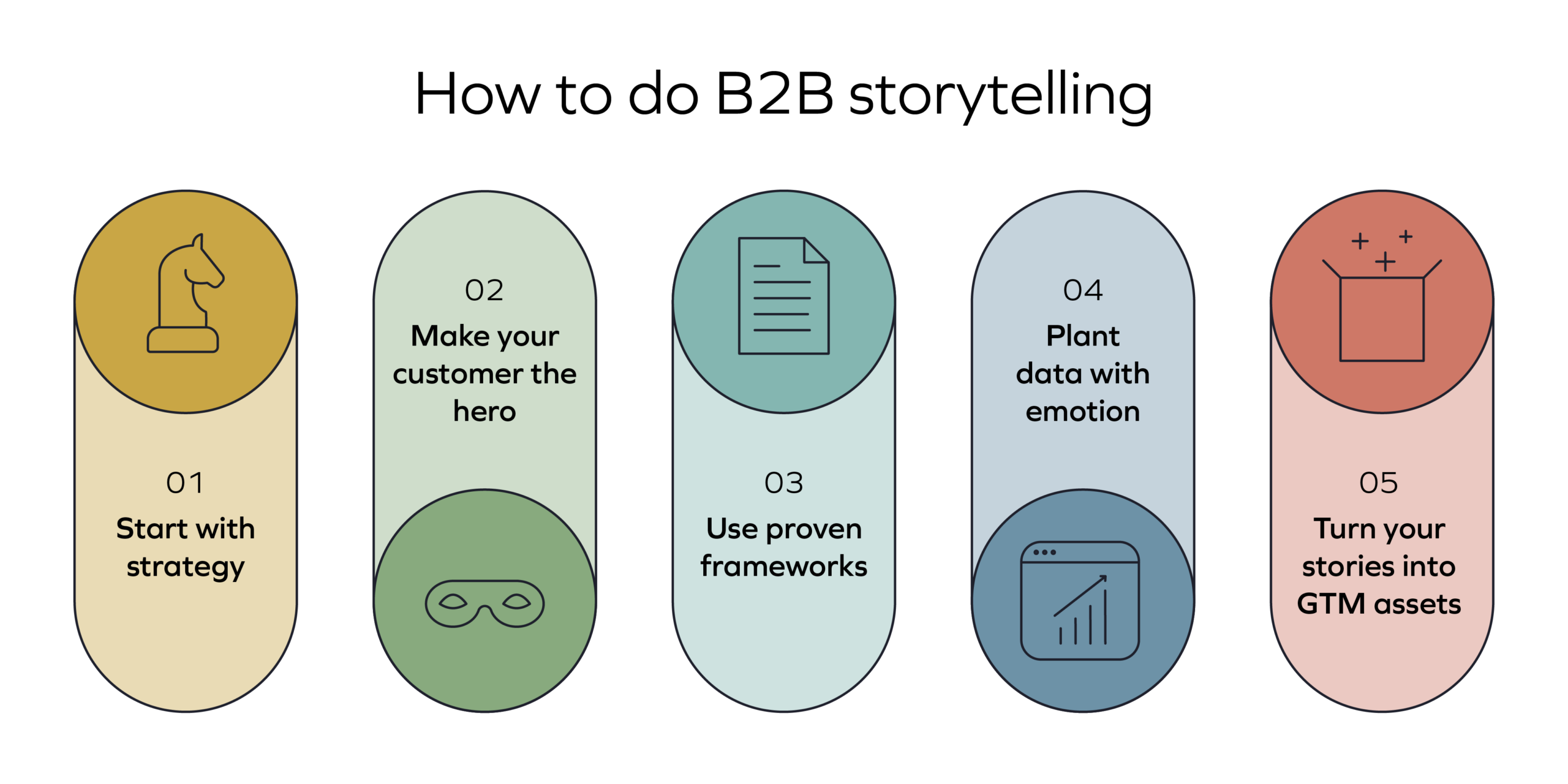
1. Start with strategy, not just a story

Before you write a single word, ask: what’s the goal?

  • Are you driving awareness?
  • Moving prospects through the funnel?
  • Enabling your sales team?
  • Reinforcing your positioning?

Storytelling is positioning in motion. Without a clear objective, even the best-crafted narrative will miss the mark.

2. Know your audience like you know your product

Every great story starts with the audience. Build a ‘story persona’ alongside your buyer persona. Understand:

  • Who they are (roles, industries, seniority)
  • What they care about (pain points, motivators)
  • How they consume content (email, LinkedIn, video, podcasts)

This will ensure your story lands where it matters most.

Animation of a superhero
Diagram showing the stages of brand storytelling

Culture, purpose, and the power of internal stories

Don’t forget the stories inside your walls. Culture stories – like how your team rallied to launch a product in record time, or how a junior developer’s idea became a flagship feature – can be just as powerful as customer stories.

And purpose-driven narratives? They’re not just for B2C. Edelman’s research shows that B2B buyers are 4x more likely to purchase from brands that take a stand on issues they care about.

So tell the story of your mission. Why you exist. Who you’re here to help. And how your team lives that purpose every day.

At our GTM agency, we’ve seen how storytelling can do more than attract attention – it builds belief. It earns trust. It drives growth. If you’re looking to stand out in a crowded market, start with a story worth telling.

And if you’re not sure where to begin? That’s where we come in.

FAQs

A: A case study is a format. Storytelling is a technique. The best case studies use storytelling to make the content more compelling and memorable.

A: Absolutely. Even technical buyers respond to emotive narratives that deliver on clarity, context, and outcomes – just tailor the tone and detail.

A: We find that customer success stories, founder origin stories, product innovation journeys, and purpose-driven narratives tied to industry trends are all great ideas to explore.

Key takeaways

  • Start with the strategy
  • Make your customer the hero
  • Use proven frameworks
  • Blend data with emotion
  • Turn your stories into GTM assets

Insights

More for you


Design trends to look out for in 2025

Rich
Rich 1 min 7 Jan 2025

It’s time to bid farewell to 2024 and thank it for its contribution to design. In years to come we may look back fondly at its 3D bubble type and punchy colour gradient backgrounds. But now, as we enter 2025, the design world is (as ever) poised to embrace fresh, innovative ideas. Here’s a look at the trends we think will define the year ahead:

1. Inclusive design

Design in 2025 will prioritise accessibility and inclusivity, ensuring that products, websites, and apps are usable by people of all abilities. In fact, when the European Accessibility Act comes into play in June, brands wanting to sell products or services in Europe could be fined for not making them more accessible. As the year progresses, expect to see more adaptive layouts, diverse imagery, and clearer interfaces that cater to a wider audience.

2. Minimalist maximalism

While minimalism only took root in the latter part of the 20th century, maximalism can be traced back to the Baroque period. But enough of the past. The immediate future suggests a blend of these opposing styles. Minimalist maximalism combines sleek, simple layouts with bold, expressive elements. Think clean designs with bursts of vibrant colours, intricate patterns, and strong typography, balancing minimalism with maximalist energy.

3. AI-Powered design

While the once futuristic concept of Artificial Intelligence is already getting a bit old hat, AI will continue to revolutionise design. From generative art to AI-assisted workflows, expect AI tools to streamline processes, inspire creativity, and help designers craft highly personalised experiences with efficiency and precision. Fortunately for Torpedo’s Creative team, it can’t think as conceptually as we can.

4. Abstract and geometric patterns

In 2025, abstract and geometric patterns will make a bold comeback. And about time, too. (Bridget Reilly, anyone?) These designs will offer a dynamic, futuristic aesthetic, breaking away from traditional shapes and embracing asymmetry, layered textures, and vibrant colour schemes.

5. Motion graphics

If you want to move your audience (and some product) get your graphics to get a wiggle on too. Motion graphics will dominate digital experiences, adding dynamism and interactivity to everything from websites to social media. Expect smooth animations, scrolling effects, and transitions that engage users and create an immersive, fluid experience.

6. Scrapbooking / Collage style

They say nostalgia isn’t what it used to be, but let’s talk about what it will be – a significant trend in 2025. That’s because we’re expecting scrapbook and collage-inspired designs to make a return. Layered textures, torn edges, and mixed-media visuals will offer a creative, personal touch, evoking a sense of playfulness and authenticity.

7. Dark mode

Dark mode isn’t going anywhere. With its sleek, modern look and energy-saving benefits, dark mode will continue to thrive across apps, websites, and devices. Expect designers to innovate with dark-themed interfaces that balance readability and style. And maybe look forward to charging your laptop less.

8. Custom and dynamic typography

You can spot a decade by its most popular typeface. In the 1960s it was Univers, in the 1990s, Arial. And some designers may remember the 1980s with its s p a c e d l e t t e r i n g. But while sans-serif will no doubt continue to dominate the web, typography will become more fluid and dynamic in 2025. Custom fonts and animated typography will add personality and creativity to design projects, with letters that shift, interact, or change based on user behaviour or context, creating a more engaging experience.

Of course, predictions are always an area to tread carefully in, especially when you’re committing them to print – or in this case a website. But whether or not you revisit this page in 2026 to check back on just how insightful we folks at Torpedo were (or weren’t), the above trends are the ones we think it’s useful to know about now.

Especially if, like most designers, you want to be ahead of them.


Insights

More for you


Make extraordinary collaboration with sales part of your new normal

Andrew
Andrew 1 min 14 Dec 2024

Updated for 2024

For years now, B2B marketing has been dominated by digital content, digital channels, and digital tools. As marketers, we’ve built processes that enable a test-and-learn approach with real-time measurement, rapid iteration, and on-the-fly optimisation. We’ve become adept at reaching audiences virtually – quickly scaling up what works, dialling down what doesn’t. Digital is our strength.

For many sales teams on the other hand, success is built on relationships. Understanding customers on an individual level. For many, face-to-face engagements are considered the most valuable. However, whether we’re talking regular sales meetings, new product demos, industry expos, or other networking events, live and in-person opportunities to connect took a hit during COVID, and it’s doubtful face-to-face interaction will ever be the same again.

Maybe, then, it’s time to step up and stand side-by-side with our sales counterparts and work together better. Because right now, marketers have a real opportunity to show what they can do. And the best way to do it could be closer collaboration with sales.

So, here are ten insights that we believe could help you make friends and influence sales.

Consider the foundation: data integration and unified platforms.

Marketing and sales teams must operate from a single source of truth. This means implementing comprehensive Customer Data Platforms (CDPs) that consolidate information from all touchpoints. The traditional siloed approach, where marketing uses one set of tools, and sales another, simply won’t suffice in the modern landscape.

Account-Based Marketing (ABM) will evolve into Account-Based Experience (ABX).

This shift represents more than a mere terminology change. While ABM focuses on targeting specific accounts, ABX encompasses the entire customer journey. Marketing and sales teams need to collaboratively create personalised experiences at every interaction point. This might involve developing industry-specific content, tailored virtual events, and customised communication sequences.

The rise of AI will reshape how we approach lead qualification and nurturing.

AI-powered tools will become increasingly sophisticated at predicting buying intent and identifying optimal engagement times. However, the human element remains crucial. Marketing teams should focus on training AI systems with high-quality historical data while maintaining the personal touch that B2B relationships require – and that sales teams are so adept at.

Revenue attribution models need significant refinement.

The traditional marketing qualified lead (MQL) to sales qualified lead (SQL) pipeline is becoming outdated. Instead, organisations should adopt revenue-based marketing metrics that align with sales outcomes. This means tracking metrics like pipeline velocity, account engagement scores, and customer lifetime value predictions.

Content strategies require a fundamental shift.

Rather than creating general thought leadership pieces, marketing teams should produce sales-enabled content that directly supports different stages of the buying journey. This content should be easily customisable by sales teams for specific account interactions. Think modular content pieces that can be assembled into personalised presentations or proposals.

Consider the power of CRM as a Content Intelligence Hub.

Modern CRM systems serve as far more than just contact databases – they’re goldmines of customer intelligence. When sales teams diligently record their client interactions, particularly through call recordings and detailed notes, they create an invaluable repository of authentic customer language and concerns. Think how a prospect typically expresses their challenges in their own words, often quite differently from the way we might describe them in our marketing materials. While marketing might write about “Optimising operational efficiency,” a customer in a sales call might say, “We’re wasting hours every week manually updating spreadsheets.” This raw, unfiltered feedback becomes the foundation for creating content that truly resonates. Marketing teams can analyse these recordings and notes to:

  • Develop FAQ content that addresses actual customer questions rather than assumed pain points
  • Create case studies that speak directly to commonly expressed challenges
  • Refine product messaging to match customer language
  • Design sales enablement materials that address frequent objections captured in these

Internal processes need restructuring to support this alignment.

Consider implementing regular revenue team meetings where marketing and sales collaborate on account strategies. Create shared KPIs that encourage cooperation rather than competition. Both teams should have access to and understanding of each other’s tools and metrics.

The role of marketing operations becomes increasingly critical.

This function serves as the bridge between marketing and sales, managing the technical infrastructure and ensuring smooth data flow between teams. Investment in marketing operations capabilities, including technical expertise and process management, will be essential.

Setting expectations for the entire customer experience is critical.

Think of marketing as creating a promise to prospects – every subsequent interaction must fulfil that promise. This alignment needs to extend beyond just marketing and sales to encompass every customer-facing department. For example, if your marketing promotes “expert technical support available 24/7,” your support team needs to be equipped and structured to deliver on this promise. Similarly, if your content emphasises innovative solutions and cutting-edge technology, your product demonstrations need to reflect this positioning. Any disconnect between marketing messages and actual experience can severely damage trust and credibility.

Customer success should be integrated into the marketing-sales alignment.

The post-sale experience directly impacts renewal and expansion opportunities. Marketing needs to collaborate better with customer success teams, to create advocacy programmes and case studies that sales can leverage in their conversations.

Finally, of course, collaboration is like conversation – it’s a two-way thing. Marketing teams need to understand sales processes and technologies, while sales teams need to grasp marketing analytics and digital engagement strategies. Skills development will continue to be important – cross-training programmes and job rotations between departments can help build a mutual understanding.

And for businesses and brands, that’s when collaboration delivers remuneration.


Insights

More for you


Doing more with less: Guerrilla Marketing in B2B

Sandra
Sandra 1 min 19 Jun 2024

In the challenging landscape of B2B marketing, managers are increasingly faced with a daunting challenge: maximising impact while navigating tighter budgets. In one of our recent articles, we explored the ways of how revenue-focused marketers can squeeze the most of their B2B marketing and media budget – but how does guerrilla marketing fit into this?

As we push forward into 2024, the need for innovative and cost-effective marketing strategies becomes more critical than ever. Amidst such constraints, guerrilla marketing emerges as a beacon of opportunity – a strategic approach that leverages creativity and surprise rather than hefty advertising budgets to captivate an audience.

In this article we will explore how B2B companies can employ guerrilla marketing tactics to not only survive but thrive in a competitive market landscape. We’ll explore the essence of guerrilla marketing in the B2B context, share actionable strategies, case studies, and guide you through implementing these tactics effectively.

Understanding guerrilla marketing in B2B context.

Definition and key characteristics.

Guerrilla marketing, a term coined in the 1980s, refers to the use of unconventional and innovative tactics, designed to achieve maximum exposure and impact from minimal resources.

Traditionally seen as the playground for B2C adventurers, it’s rightfully finding its place in the B2B realm. Advocated mostly by start-ups and tech companies, this unconventional method can generate significant attention and engagement while keeping costs low.

This approach is characterised by surprise, creativity, and irregular strategies that break away from traditional marketing norms. In the B2B sphere, guerrilla marketing is not merely about generating buzz – it’s about creating valuable connections and impressions that lead to lasting business relationships.

Distinctions between B2B and B2C guerrilla marketing.

While both B2B and B2C markets can benefit from guerrilla marketing, the tactics differ significantly in their execution and objectives.

B2C campaigns often focus on broad, emotional engagement and instant gratification to drive consumer actions. In contrast, B2B guerrilla marketing strategies are more about forming meaningful partnerships, demonstrating industry leadership, and engaging a narrower, more targeted audience with tailored messages that resonate on a professional level.

Relevance of guerrilla marketing in today’s economic landscape.

In today’s economic environment, where every marketing dollar needs to work harder, B2B companies particularly feel the pressure to deliver more with less. The high costs of traditional advertising and the saturation of digital ad spaces make guerrilla marketing an attractive alternative. This approach allows B2B marketers to bypass expensive media buys and instead focus on creating impactful, memorable interactions that foster business relationships and drive lead generation.

Guerrilla marketing thrives on creativity and agility – qualities that are indispensable in a turbulent market. By adopting these tactics, companies not only manage to cut costs but also differentiate themselves from competitors who might stick to more conventional methods.

Core strategies to consider.

Guerrilla marketing strategies are all about creativity and connection. They’re designed to make your B2B marketing more impactful, memorable – and yes, even a little fun – all without requiring a blockbuster budget.

So how you can get your B2B brand noticed?

Tactic #1: High-impact, low-cost content strategies

  1. Expert Roundups and Thought Leadership: B2B marketing is all about building credibility and trust with your target audience. So how about pulling together insights from several industry gurus into a powerhouse content? A collaborative eBook written in partnership with industry experts (or even your clients) or hosting a joint webinar (that could be further leveraged to fuel your social media content) is a fantastic way to piggyback on others’ authority and reach. Plus, when the co-authors share your content, their followers will get to know you too.
  2. Webinars and Live Demos: Think beyond the typical slideshow – host a webinar or a live demo that tackles hot topics in your industry. Get interactive with real-time Q&As to keep viewers hooked and hungry for more. Bonus points if you record all the questions from the participants as they could become an invaluable source of ideas for your further content!
  3. Infographics and Data Visualisations: Do you have access to unique data? Turn those numbers into eye-catching infographics or digital PR stories that highlight trends or success stories. Visual summaries of data and overarching trends are perfect for grabbing attention on social media and beyond – and might even help you acquire high-authority backlinks, which will help you amplify your organic visibility.

Tactic #2: Creative digital moves to outsmart your competitors

  1. SEO Hijacking: Create content that capitalises on trending keywords within your industry, but with a unique twist that highlights your company’s perspective or solutions. While having a well-crafted SEO strategy is vital for a successful content strategy, it’s important that you blend both reactive and evergreen content for maximum results.
  2. Viral Challenges: Initiate industry-relevant challenges that encourage interaction and sharing among professionals in your field. This can significantly increase your social media engagement and brand visibility. This exercise is also invaluable when it comes to creating a community – something that is desperately sought after in today’s state of B2B marketing.
  3. Augmented Reality (AR) Experiences: Develop simple AR filters or interactive experiences that can be accessed via smartphones. These could demonstrate your product’s features or simulate the product experience in a memorable way.
  4. Using AI: Recent Gartner research revealed that demand generation remains a top priority for B2B CMOs in 2024. Sharing your knowledge is one of the most effective strategies to educate potential buyers, fostering trust in your expertise and encouraging future partnerships. A clever way to keep your audience informed is by creating an AI-driven database of information that they can interact with. Given that most B2B buyers now prefer self-service tools for decision-making (often bypassing sales representatives), an AI tool filled with all the information your prospects might seek is an excellent way to capture their attention.

Examples of guerrilla marketing for B2B enterprises.

While mostly used by start-ups and small companies, guerrilla marketing can be easily applied to global B2B enterprise marketing strategies.

Here are some examples of how to cleverly use your B2B marketing budget to create a marketing campaign that stands out:

Turning a book into a ChatGPT bot.

If you are a huge social media enthusiast (like me), there’s a good chance you’ve come across Andy Lambert, a founding member of the social media scheduling tool, ContentCal (now part of Adobe).

Andy has built a strong personal brand and decided to enhance it further by publishing his own book – Social 3.0. Although the printed publication achieved significant success, Andy decided to elevate his digital presence by releasing the book as a GPT.

With a free, GPT version of his book, Andy enabled his followers to access it freely, ask questions, and learn key insights on building a B2B brand on social media. This approach not only provided users with a preview of the book’s content but also showcased Andy’s unique expertise, further accelerating his digital footprint.

Remember that guerrilla marketing thrives on the element of surprise. By catching your target audience off guard with unconventional tactics (such as a GPT version of your knowledge), you can create memorable experiences that set you apart.

“The End of Software” campaign by Salesforce.

Now regarded as one of the biggest CRM solutions on the market, Salesforce was a pioneer of guerrilla marketing back in 2000 – all thanks to their ‘End of Software’ demo which declared that enterprise software was a thing of the past. The central message was that the future of CRM, and business software in general, lay in cloud computing, which offered greater flexibility, lower costs, and easier updates compared to traditional software.

Salesforce’s bold strategy involved staging a mock protest during the Siebel Systems’ user conference, a major event for one of the leading CRM providers at the time. Salesforce hired actors to pose as protesters, who then demonstrated outside the conference venue carrying signs and chanting slogans like “The End of Software.” These protestors held up large placards with anti-software messages, making a direct and audacious statement against the traditional software model and advocating for Salesforce’s innovative cloud approach.

The “End of Software” campaign helped Salesforce rapidly build brand awareness and credibility in the CRM market. It showcased the company’s willingness to challenge the status quo and positioned them as a forward-thinking and disruptive force in the industry.

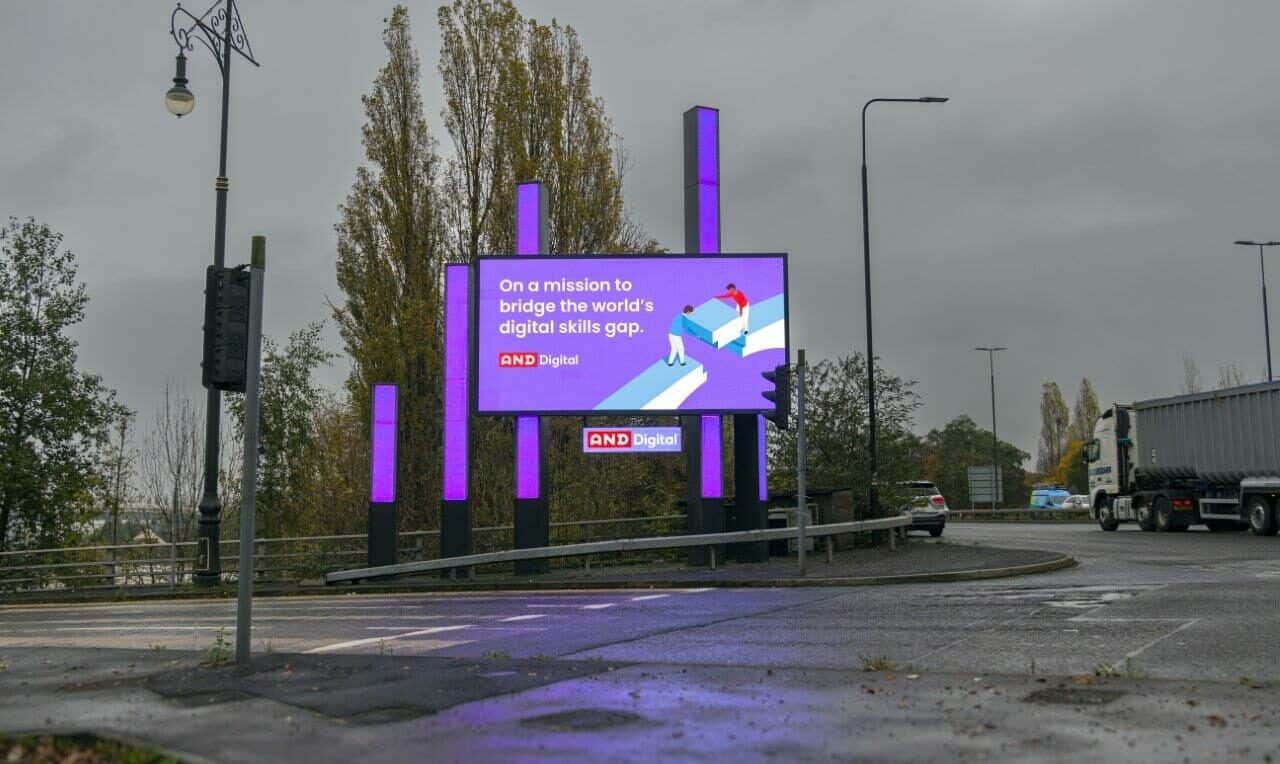
One of the digital billboards for our OOH campaign for AND Digital.

Putting the Ooooh into OOH adverts.

Full disclaimer – this campaign was delivered by our super talented team at Torpedo!

AND Digital, a digital development consultancy, held a ‘town hall’ meeting at Victoria Warehouse, Manchester to celebrate their staff. With over 1,300 ‘ANDis’ arriving from around the UK and Benelux region, the company wanted to make a big splash.

At Torpedo, we created a series of eye-catching, OOH (Out of Home) adverts around Manchester to build expectations for arriving attendees as they journeyed to the event. Our key objectives were to celebrate ANDis and make them feel like the whole city was gearing up to welcome them.

We ran six digital billboards with brightly coloured creative ads, depicting people ‘working together to close the digital skills gap’. The precise ad messaging had an overarching mission statement appealing to all ANDis, while also enticing new clients and inspiring future employees.

The placement of the ads was critical. Our goal was to line the routes to the venue. While we placed large billboards at strategic locations – we also needed an alternative way to engage pedestrians. We achieved this with over 30 striking adverts that were power-washed through stencils into pavements around Manchester, creating a ‘reverse graffiti’ effect. Our two designs included the company’s logo and website URL with messaging welcoming staff to the city. This cost-effective method was also environmentally friendly, disappearing naturally over time.

Direct mail campaign with a twist.

Aladdin Knowledge Systems, now part of SafeNet, executed a highly inventive guerrilla marketing campaign aimed at engaging financial professionals and bankers, a key segment for their IT security solutions.

Aladdin sent out remote control toy Hummers to their target audience. The packaging was transparent, allowing recipients to see the toy, which sparked immediate interest and curiosity. But there was a catch; the remote control needed to operate the toy was deliberately excluded from the package. To obtain it, recipients had to schedule a meeting with Aladdin’s business development team, ensuring direct engagement with potential leads.

The result? The campaign provided Aladdin Knowledge Systems with meetings with 35% of the recipients, showcasing a high engagement rate for a B2B marketing effort. The overall cost per lead was kept under $20, making it an economical strategy with high potential for return on investment.

Conclusion.

In a market where traditional methods are becoming less effective and budgets are under pressure, guerrilla marketing presents a valuable opportunity for B2B enterprises. By thinking outside the box and embracing creativity, you can make a significant impact without breaking the bank. Remember, it’s not about how much you spend, but how creatively you can engage and surprise your audience.

Implementing guerrilla marketing strategies can help you stand out, build lasting connections, and achieve your marketing goals even in the toughest of times. If you’re looking to revolutionise your marketing approach and maximise your budget, our full-service B2B marketing agency is here to help. We specialise in creating innovative and cost-effective B2B marketing campaigns that drive real results. Get in touch with me today to learn more about how we can support your business.


Insights

More for you


B2B Social Media Copy: 10 top tips for success

Sandra
Sandra 1 min 6 Feb 2024

In the ever-changing world of social media, creating copy for B2B audiences is an art that calls for finesse and a smart strategy. Each platform is a new opportunity – knowing how to make the most of it can really boost your engagement and following. So, let’s break down these strategies together to make sure your B2B social media copy not only talks the talk but also walks the walk – on every platform.

1. The influence of individuals

Your people are the voice of your company, so let them be heard. Encourage your team to share their own content, full of thoughts and opinions, to make your company more relatable. The influential people within your organisation have personal brands that can make a big difference – they can be promoted for Thought Leadership ads on LinkedIn. The more genuine their insights are, the more it adds authenticity to your brand, building trust as well as making your online presence more compelling. It’s not just about your company – it’s about the people behind it, sharing real stories and making connections.

2. Social ads pay off

No matter how good the copy is within your social ads, if people don’t see it, it’ll go to waste. Invest in your paid social media with targeted campaigns. Utilise analytics to fine-tune and optimise the performance of your ads. Paid ads are also a great tool to test the messaging and conduct A/B copy tests to see what resonate with your audience. Ensure that your paid strategies align with the broader goals of your business. This approach helps you to maximise the reach of not only your copy, but the impact of your campaigns.

3. Get to know your audience

You need to know who it is your copy is targeting – you need to grab their attention and keep them engaged on the platform. Begin by conducting thorough audience research to create content that resonates with their interests. Develop compelling and relevant posts that not only capture their attention but also encourage them to stay on your social media channels. Utilise analytics tools to track user behaviour and preferences, allowing you to refine your content strategy based on real-time insights.

4. Hashtags – it’s quality over quantity

Hashtags are an important tool when it comes to getting your content seen by the right people. As a rule, the quality of those hashtags matters a lot more than the quantity. So, select hashtags that are relevant and specific to your content – consider a mix of generic and branded hashtags to boost your brand recognition. Avoid overwhelming your posts with too many hashtags, as this can dilute your message and make it less effective.

Post-it not with the words

5. Call to action

Often overlooked is a Call to Action (CTA) – a must-have when it comes to social media copy. Small but mighty, CTAs work as a signpost, telling your followers what to do next. CTAs involve using powerful action verbs to prompt engagement and drive desired actions. The goal of social media copy is to keep users on your platform, channels like LinkedIn and Facebook reward native content that does so – the more valuable the content the better for keeping your audience hooked. In essence, CTAs are your friendly nudge, inviting your followers to participate and interact in meaningful ways.

6. Time to talk the talk

The way you talk to your audience matters. Make sure that all your brand communications have a consistent tone no matter which social media channel you’re on. Your voice should be instantly recognisable to those viewers. In comparison to B2C copy, B2B copy tends to be more formal and professional but that doesn’t mean dry or boring. You should tailor the tone to connect with your intended audience, finding the right balance between professionalism and relatability.

7. What makes you, you

Your value proposition is what sets you apart, so you need to tell people that. Articulate the distinctive value only your business provides, spotlighting the benefits and solutions you offer to address your customers’ pain points. It shouldn’t be too salesy though – the key is to strike the balance between educational and promotional. The aim is to put your brand in a different league to your competitors, with content that’s value driven.

8. Be a goal-getter

Set clear goals for your B2B social media, and make sure they align with your broader business objectives. Utilise key performance indicators (KPIs) to see the success of your strategies. Regularly dive into the analytics, analysing performance metrics and be prepared to tweak your approach as needed. Continuous assessment ensures your strategies are not just on point but actively boosting your overall business success.

Hands of robot and human touching on big data network connection background

9. Add some personality to AI

As AI technology continues to grow in popularity, it’s important to embrace its efficiency and not get left behind. Whether you’re diving into data analysis, crafting compelling content or planning your social media posts, let AI be your ally. However, you need to make it personal, AI is only as good as the information you feed it with. Tailor AI-generated content to resonate with your brand’s tone of voice. Steer clear of generic automation and opt for that personal touch that makes you authentic. It’s not about being a copy and paster – it’s about letting AI enhance your creativity and efficiency.

10. Get straight to the point

When it comes to your social media content, cut to the chase and steer clear of confusing jargon. Keep it short, snappy and clear. Use specific terminology that resonates with your ICP and say goodbye to unnecessary jargon that leaves your audience scratching their heads. Aim for a message that’s not just clear but compelling – something that grabs attention and leaves a lasting impact.

B2B social media copy demands a tailored touch, there’s no one-size-fits-all solution. It requires continuous analysis, strategic adjustments and a commitment to adaptability. Engaging your B2B audience demands dedication, but the potential rewards are well worth it.

By incorporating these 10 tips into your approach, you can elevate your social media game, ensuring your content resonates across diverse platforms. Embrace the evolving social media landscape to craft compelling B2B copy that stands out. Get ready to witness the impact of your efforts in this digital world.


Insights

More for you


Why video is the most powerful way to reconnect with your customers

Damian
Damian 3 min 11 Sep 2020

The world has changed in ways we could never have imagined. People’s routines and priorities have shifted, and the way they live their lives and purchase goods and services are significantly different now from even a few months ago.

Businesses need to think hard about how they adapt to this new landscape, and particularly how they reconnect with their customers and build meaningful, lasting relationships. We think that the strongest and most engaging way to do this is through video.

Video has unique impact.

Video offers so many levels for your business to connect with your customers. Within a video you can create trust and unite with your customers on an emotional and intellectual level. It’s a great way of deepening the relationship between your brand and your customers, and if done right, will help develop a bond that will breed loyalty, recognition and trust.

Your audience awaits.

And the great news is – your audience is out there, ready and waiting to watch your video content. Research from Cisco predicts that nearly four-fifths (79%) of the world’s mobile data traffic will be video by 2022, and that by then online videos will make up more than 82% of all consumer traffic – 15 times higher than in 2017.

Many businesses are already responding to the consumer appetite for more visual content, and are building video into their marketing strategy to build sales, brand awareness and trust with a growing customer base. According to Wyzowl’s 2020 State of Marketing report, 85% of businesses have incorporated video into their marketing strategy this year, and more than 83% of marketers attest that video content provides the best return on investment.

Where are customers most likely to watch marketing videos?

Where are customers watching these videos? Social platforms such as Instagram, YouTube and Facebook are the most common. According to Buffer, 81% of businesses now prefer to use Facebook for their video marketing. Sriniras Narayanan, Facebook’s Director of ML/AI sums up the popularity of video in consumer marketing by saying, “If a picture is worth a thousand words, a video is a library.” If you’d rather put a more specific numerical value on it, digital marketing expert James McQuivey believes that 1 minute of video is equal to 1.8 million words.

Aside from social, there’s compelling evidence that video content can be an excellent way of encouraging customers to engage with your company’s own marketing platforms. A 2017 study revealed that using video on landing pages can increase sales conversions by 80%. And simply mentioning the word ‘video’ in your email subject line can increase open rates by 19%.

You don’t even need to try and persuade your customers that video is a useful part of the buying process – they’re already convinced. A massive 90% of consumers reported that video helps them make buying decisions, while 64% say that seeing a video makes them more likely to buy a product or service.


Insights

More for you


5 ways B2B marketeers can use Google Trends to inform strategy.

Andrew
Andrew 6 min 9 Apr 2020

Things change so quickly these days, it’s difficult for businesses to keep track. But fear not, B2B marketeers, there’s something out there that is tracking all those changes for you. And best of all it won’t cost you a penny.

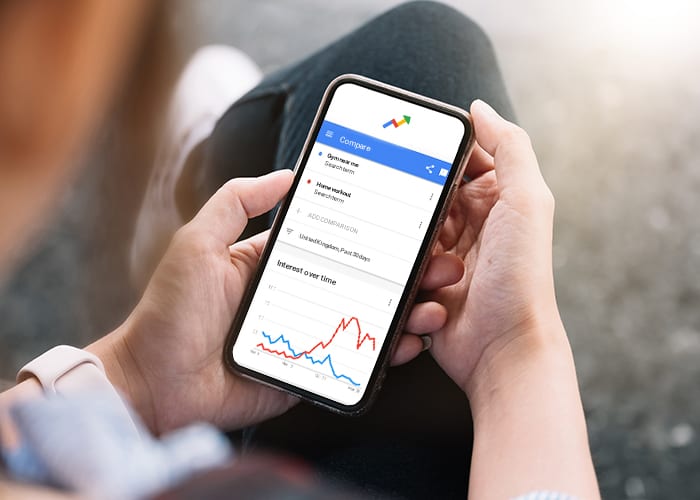
Google Trends is a free tool that allows users to see trending searches and topics on Google Search. The tool is designed to organise the world’s information and make it universally accessible and useful. Although devised to feed the curiosity of the general public, Google Trends can also be used by businesses – as the provider of a wealth of data to help inform crucial marketing decisions and react to changing trends. If you work in B2B marketing, then we have picked out various scenarios to demonstrate where the tool could help you with your marketing efforts, too.

Scenario 1.

“I want to find out how an event has changed demand in my industry”

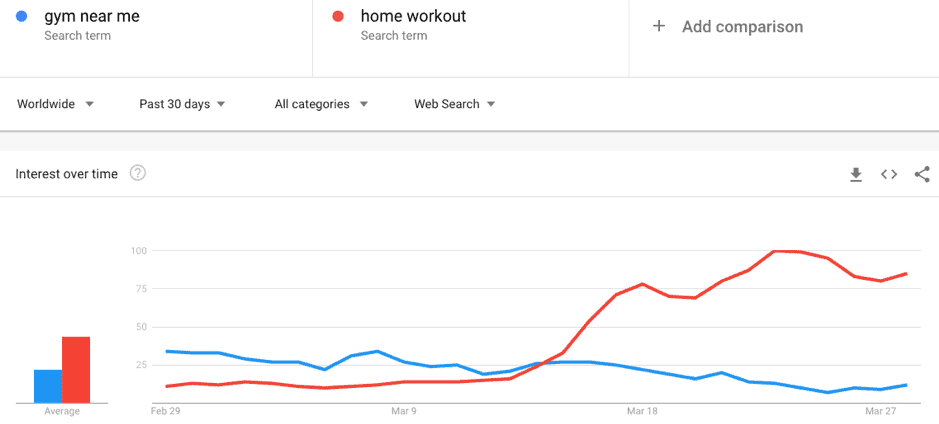
World events can cause a sudden shift in demand within your industry. As we all know, the recent Coronavirus outbreak caused sudden changes in demand that the vast majority of businesses were totally unprepared for. However, you can uncover the nuances of these demand shifts within Google trends. For example, any business related to fitness products may be keen to find ways to exploit the graph below. It shows the interest in the search term “gym near me” versus “home workout” throughout March 2020. The government-imposed lockdown throughout this period has caused a drastic change in search interest. At the start of the month “gym near me” was the more popular search term. By the end of the month, the graph paints a very different picture. “Home workout” proves a way more popular alternative for those keen on keeping in shape throughout the pandemic.

5 ways B2B marketeers can use Google Trends to inform strategy.

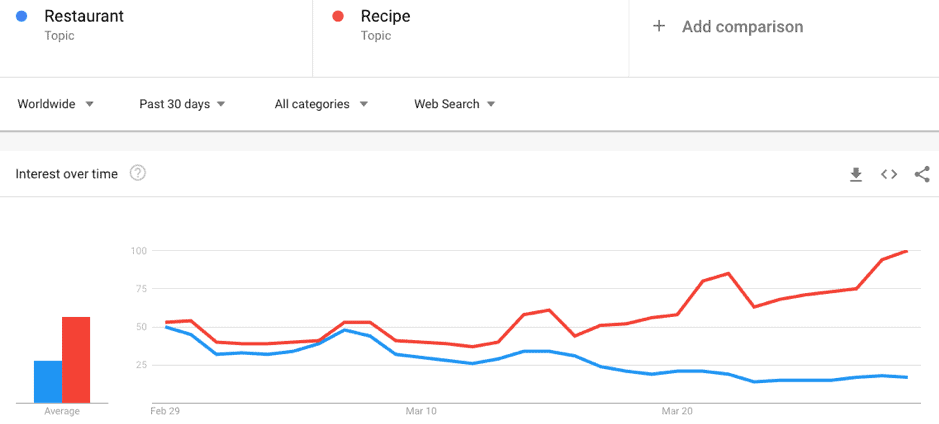
Similarly, the example below demonstrates the way consumer eating habits have changed. The graph compares the search interest in the restaurant topic compared to the recipe topic. The two were more or less neck and neck in terms of search interest at the start of March 2020, but a gulf has grown between them since the outbreak of COVID-19. Why? Well, it’s possible avid restaurant goers are trying their hand at replicating popular restaurant recipes to get a similar culinary experience at home. That’s big news if you’re a supplier of specialist ingredients.

5 ways B2B marketeers can use Google Trends to inform strategy.

Scenario 2.

“I want to find out how interest in my product compares to my competitors”

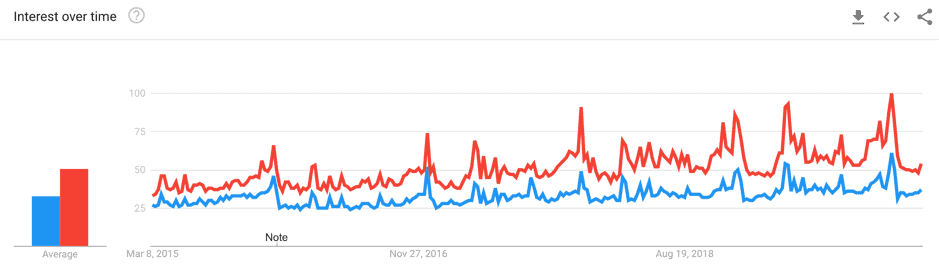
With information so readily available, it’s more important than ever to check how you stack up against your rivals. Within Google Trends you can benchmark search interest in your product, service or brand – as highlighted in the example below, comparing budget supermarkets Aldi and Lidl. The line graph represents the interest in each search term over time, on a scale from 0 to 100. The higher the number, the more popular the search at a given time. This follows a very similar trend for each supermarket which also highlights the seasonality of search interest, peaking around Christmas each year.

5 ways B2B marketeers can use Google Trends to inform strategy.

Scenario 3.

“For market expansion, I want to find which regions are most interested in my product”

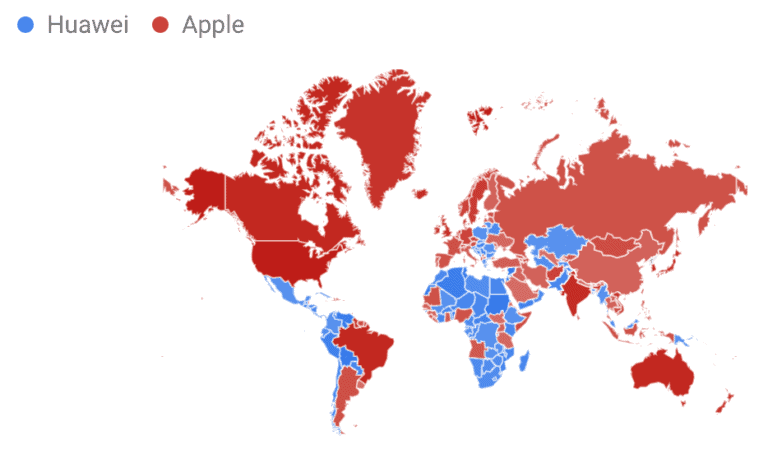
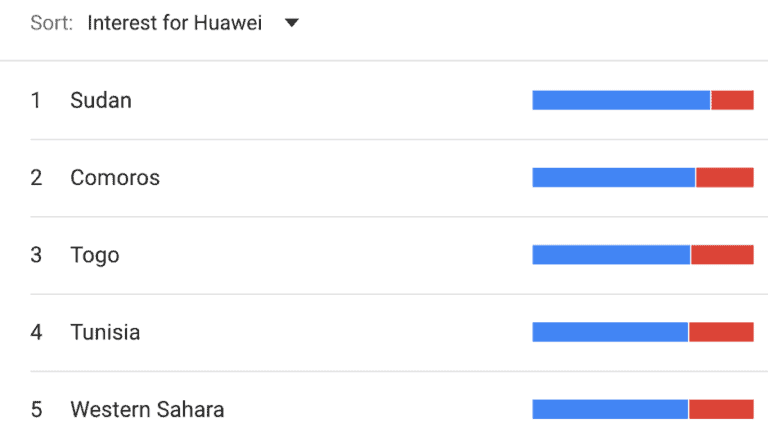
Selling your products and services globally has never been easier than it is today. This makes the idea of market expansion very attractive. With Google Trends, you can filter search interest down to regions and cities, allowing you to identify potential regional expansion prospects. The map in the image below shows the regional split in search interest between Apple and Huawei, and represents the countries each brand is most widely searched in. The regions areas in which Huawei commands a larger market share over Apple are clearly visible. Interestingly, Huawei seems to dominate much of central America and Africa, while Apple remains prominent in the rest of the world.

5 ways B2B marketeers can use Google Trends to inform strategy.

Scenario 4.

“I want to identify regions that are dominated by my competitors – to disrupt their monopoly”

Brands that command a monopolistic market share can be vulnerable to disruptive innovation – from grass roots firms or larger players backed by heavy investment. Google Trends allows you to identify the regions that are dominated by potential competitors that could, potentially, be vulnerable to disruptive innovation. That includes areas where your business already has a presence, but might be looking to command a larger market share through an aggressive marketing strategy.

5 ways B2B marketeers can use Google Trends to inform strategy.

Scenario 5.

“I want to find trending queries and topics around my product, to inform my content strategy”

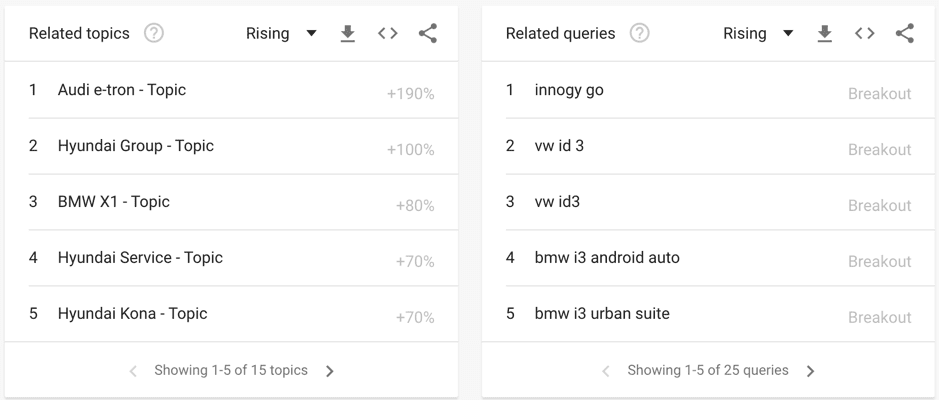
Finding topics related to your brand can help you to uncover the comparisons that searchers are making between your product and alternatives in the marketplace. Google Trends allows you to see which related topics are growing in popularity, giving you the chance to jump on the bandwagon, react to changing interests, then shift the attention from alternative brands to yours. The image below provides an example of the rising topics and queries related to the ‘BMW i3’. Notably, related topics include other key players in the electric car industry, namely Audi and Hyundai.

5 ways B2B marketeers can use Google Trends to inform strategy.

These can be sorted by the queries that are ‘Rising’ in popularity – indicating the biggest increase in search frequency – or by the ‘Top’ (most popular) search queries, overall. ‘Rising’ can also turn to ‘Breakout’. This is when a topic or keyword is receiving a massive increase and the search term has grown by over 5000% (!)

“How do I find this free information?”

Raring to go? To access the tools in the scenarios above, click on the hamburger button [menu icon] in the top left of the Google Trends homepage, then select ‘Explore’. On the Explore page, type in your search query, then click on ‘+ Compare’ to choose a search term to compare it with.

“Can I receive updates regarding trends relating to my brand or industry?”

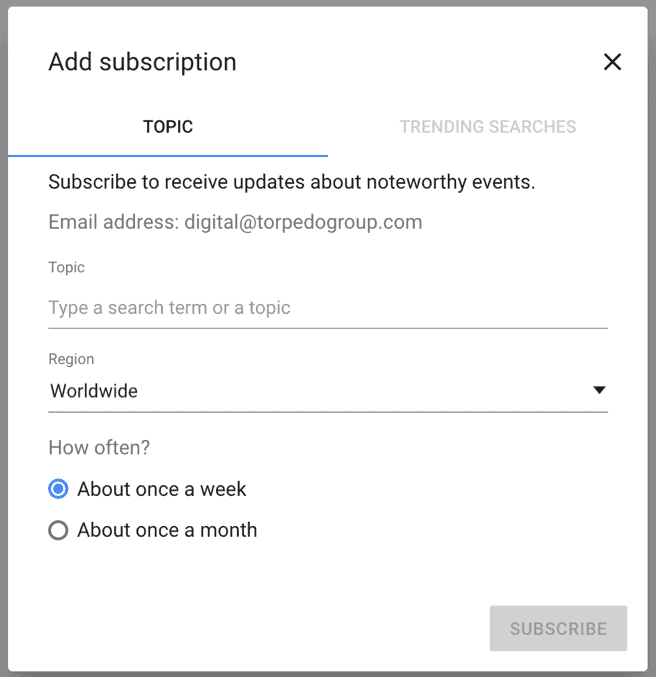
Yes. Previously, staying up to date with industry developments – and how people are relating to brand-related trends – was a tall order. Google Trends, however, allows you to subscribe to updates, so that you can receive a weekly digest on the trends that are exclusive to you. This is a perfect solution for time-poor marketers who just want the top, tailored headlines delivered on a weekly or monthly basis.

5 ways B2B marketeers can use Google Trends to inform strategy.

To subscribe to updates, again, click on the hamburger button in the top left of the Google Trends homepage, then select ‘Subscriptions’. On the subscriptions page click the ‘+’ in the bottom right hand corner, then follow the on-screen instructions to set up your subscription.

You’ll find Google Trends a great starting point for assessing search trends related to your business, but if you’d like to take things a step further and go into more detail, then talk to Torpedo. Equally, If you’d like to know more about Google Trends data then check out the Google Trends FAQs page.

Of course, even in the short time that’s elapsed since we released this blog into the world, that world will have changed yet again. What remains the same is Google Trends ability to track those changes so you can stay one step ahead of your competition.

And the fact that it’s free? Well, let’s hope that never changes.


Insights

More for you